Hillside Letters in the Conejo Valley and Greater Ventura County

There are over 500 hillside letters, or “mountain monograms,” in the United States, including 81 in California. What are hillside letters, you ask. They are simply large single letters, abbreviations and sometimes even messages erected on a hillside, usually by a school or town.

The Big “C” overlooking UC Berkeley (From Wikipedia; public domain)

The Big “C” overlooking UC Berkeley (From Wikipedia; public domain)

One well known hillside letter is a giant concrete block letter “C” built in the hills overlooking UC Berkeley that was constructed on March 23, 1905.

We have our share of hillside letters here in the Conejo Valley and Greater Ventura County, some of which you may be aware of…others, perhaps not.

The mountain monograms visible in our neck of the woods include:

The letters CLU on Mt. Clef Ridge above Cal Lutheran University are maintained by students.

Hilltop A overlooking Agoura High School up a steep hill. Made out of wood, I believe.

Here is a view of the letter VC north of Ventura College in late April 2019.

Here is a view of the letter VC north of Ventura College in late April 2019.

If you drive north up Catalina Street, west of Ventura High School, you will be able to see this letter V on the hillside.

The letter F is located in the hills west of Fillmore and is quite easy to see.

This letters SP letters in the hills south of Santa Paula is cleared brush. They originated in 1922. More information on THIS PAGE.

Happy Face Hill in Simi Valley is not a mountain monogram but is perhaps the visible hillside attraction throughout Ventura County.

Voters Chose to Incorporate the City of Thousand Oaks Over the City of Conejo in a September 29, 1964 Special Election

City of Thousand Oaks Sign

On September 29, 1964, voters in the Conejo Valley were given the choice of whether to incorporate as a separate city in Ventura County and, if so, what to name this new city. It came down to 4,601 out of approximately 7,000 registered voters that Tuesday.

In March 1963, 27 local organizations gathered to form a Conejo City Committee to take steps to bring to a public vote the incorporation of the City of Conejo.

Conejo? Yes, Conejo. A 16 square mile city. There was plenty of controversy, since the name Thousand Oaks had been used for much of this area within the Conejo Valley for over 40 years.

A group of citizens successfully petitioned to add the name Thousand Oaks to the ballot as an alternative to Conejo..  A humorous example of some of the outrage over changing the name to Conejo is seen in this letter to the editor of the local Chronicle newspaper:

"Let's Not Drop Thousand Oaks" Conejo in Spanish means rabbit, and since talk has it to change our name to Conejo instead of our good old Thousand Oaks, I then suggest we cut down all our beautiful oak trees and replace each one with a nice fat rabbit so that we can identify ourselves with the strange new name which some newcomers have thrown at us without regard or consideration of our sentimentality and perhaps foolish tradition. If one lives in the San Fernando Valley in Canoga Park or Northridge, one says he lives in Canoga Park or Northridge in San Fernando Valley. So why can't we say we live in Thousand Oaks in the Conejo Valley or in Newbury Park in Conejo Valley. I don't care how we do it, just please let's not drop the name of Thousand Oaks." -Lucia Rios de Schneider, 3107 Radcliffe Road, Thousand Oaks

There were also a number of residents who did not want to be included in the incorporation initiative, including residents of Newbury Park, residents of the Rolling Hills area south of the 101, 500 acres of Janss Corporation owned land west of Cal Lutheran, 40 acres of land east and south of the Park Oaks Shopping Center and 100 acres of land south of the 101 owned by Louis Goebel.

Election Results - A City is Born

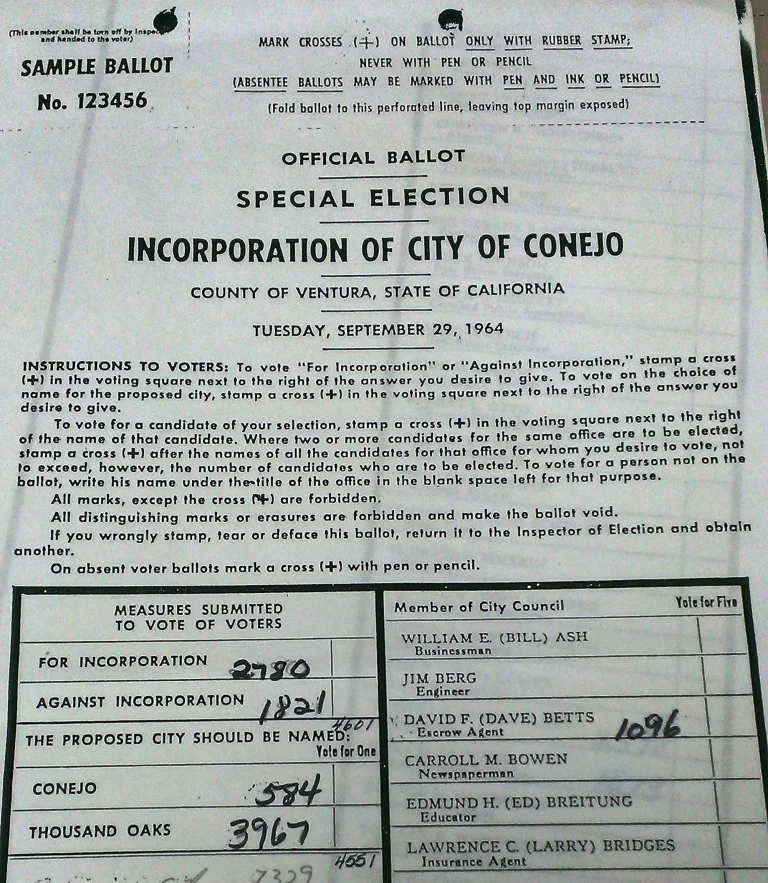
The Special Election for the Incorporation of the City of Conejo took place on Tuesday, September 29, 1964. Voting was a lot simpler back then. Instructions indicated to vote, "stamp a cross (+) in the voting square next to the right of the answer you desire to give." "On absent voter ballots mark a cross (+) with pen or pencil." The three measures submitted to vote were:

  • For or against incorporation

  • The proposed city should be named (vote for one): Conejo or Thousand Oaks

  • Vote for five city council members if the city is incorporated (there were 37 candidates on the ballot)

Portion of Sample Ballot from the September 29, 1964 Special Election for the Incorporation of City of Conejo (or Thousand Oaks, as the case were to be) (Courtesy Thousand Oaks Library Special Collections)

Portion of Sample Ballot from the September 29, 1964 Special Election for the Incorporation of City of Conejo (or Thousand Oaks, as the case were to be) (Courtesy Thousand Oaks Library Special Collections)

As you can see from the tallies written on the sample ballot above, residents voted to incorporate the city, but at 60% of the 4,601 votes it was not exactly a landslide. However, the desire to retain the name Thousand Oaks was quite clear, as 87% of votes tallied for this name over the city of Conejo.

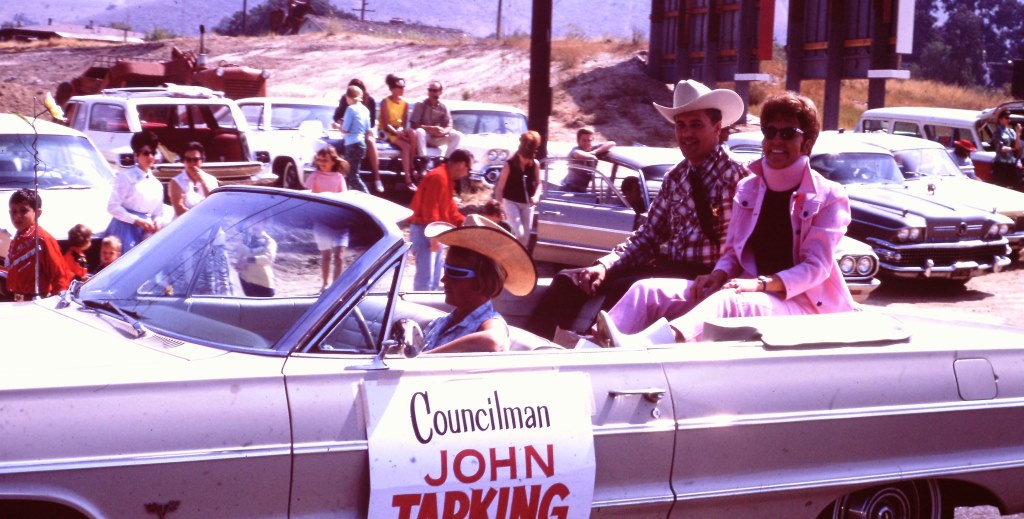
The first City of Thousand Oaks City Council consisted of pharmacist Robert Talley (2,598 votes), Ventura County planner John Tapking (1,574 votes), Accounting Chief Alexander Fiore (1,139 votes), escrow agent David Betts (1,096 votes) and engineer Lee Williams (1,056 votes).

Councilman and Thousand Oaks Mayor David Betts in the 1966 Conejo Valley Days parade.

Councilman and Thousand Oaks Mayor David Betts in the 1966 Conejo Valley Days parade.

Another one of the original city of thousand Oaks councilmembers, John Tapking.

Another one of the original city of thousand Oaks councilmembers, John Tapking.

The City of Thousand Oaks was officially incorporated on October 7, 1964. At the time, the population of the city was approximately 22,000. The U.S. Census estimates 2014 population at just over 129,000. The City turned 50 in 2014.

Where Did the Name "Thousand Oaks" Come From?

According to the late Pat Allen, historian for the city, mostly farmers lived in the Conejo Valley in 1922.  The 2,200 acre Crowley Ranch was sold and subdivided and lots were sold for $1,000. As lots sold and population grew, developers held a contest to name the new village. Sixteen year old Bobby Harrington entered the name "Thousand Oaks," he won the prize and the rest is history.

Thousand Oaks became a subdivision of Ventura County on May 1, 1923, as recorded by the County Recorder. The Thousand Oaks post office opened October 31, 1938 (compared to July 16, 1875 for the Newbury Park post office).

Sources: Thousand Oaks Library Special Collections and news articles from the Conejo News, The Chronicle and Oxnard Press Courier.

Cheeseboro Canyon vs Chesebro Road in Agoura Hills

CheeseboroApr18.jpg

Cheeseboro and Palo Comado Canyons cover over 4,000 acres in the northernmost section of the Santa Monica Mountains National Recreation Area, in the Simi Hills. The Chumash occupied these canyons for thousands of years, until ranchers came into the area in the 1800s. The natural landscape changed as a result to accommodate the needs of grazing cattle.

The National Park Service (NPS) acquired Cheeseboro Canyon in the early to mid 1980s and subsequently acquired Palo Comado Canyon (formerly known as the Jordan Ranch), in 1994.

Nearly every time we post an image from Cheeseboro Canyon to a social media site, someone points out, "it's not Cheeseboro, it's Chesebro."

Why is it called Cheeseboro when the road that gets you to the trailhead is called Chesebro?

According to one NPS Ranger I've spoken with, the original owner of the land in the late 1800s was Oscar Cheesebrough (yet a different spelling). The NPS adopted the U.S. Geological Survey spelling of Cheeseboro, while Caltrans adopted the name Chesebro.

Why the difference? That's not so clear. But what IS clear is that the actual canyon is called Cheeseboro Canyon and it is a beautiful place to hike and bike!

CheeseboroPic1.jpeg
ChesebroSign.jpg

Portrait of Ronald Reagan Made Out of 10,000 Jelly Beans at Reagan Library

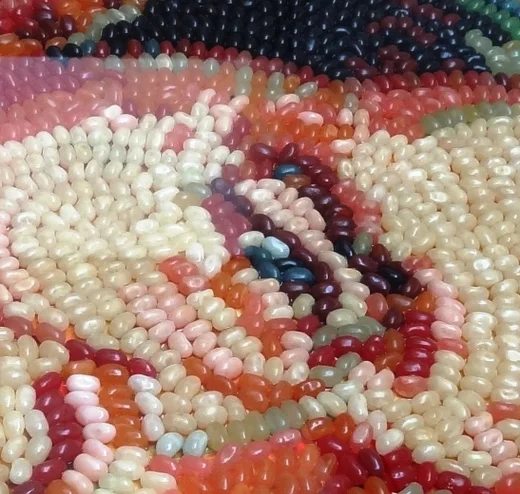
Artist Peter Rocha passed away at age 65 in 2004 from Lou Gehrig's Disease but his work lives on at the Reagan Library in Simi Valley. Rocha was famous for creating portraits out of jelly beans, including this amazing portrait of Ronald Reagan made out of approximately 10,000 Jelly Belly jelly beans.

Reagan_Rocha2.JPG
Reagan_Rocha1.JPG

Ronald Reagan once said, "You can tell a lot about a fella's character by whether he picks out all of one color or just grabs a handful." explaining why he liked to have a jar of jelly beans on hand for important meetings. His love for jelly beans makes this quite a wonderful tribute to the down to earth Reagan.

Here's a close up of a portion of his face, including Reagan's right eye. Looking at this up close one might think, hey, I could do this! But the positioning and coloring required to get those jelly beans to look so much like Ronald Reagan was a skill unique to Mr. Rocha!

Reagan_RochaCloseup.jpg

Car and Motorcycle Clubs in Ventura County

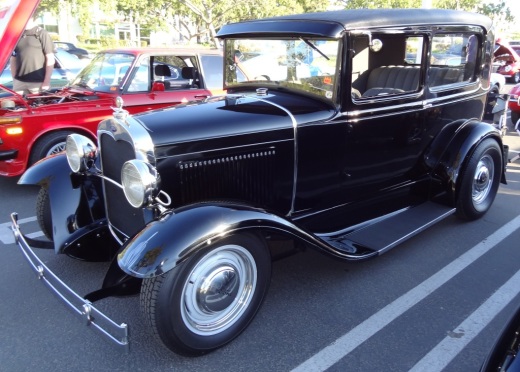
Ventura County covers over 2,200 square miles, including 1,854 miles of land. Highways in Ventura include State Routes 1, 23, 33, 118, 126 and 125 and U.S. Highway 101. That's a lot of miles to cover and we love our cars...as evidenced by these local car and motorcycle clubs in and around Ventura County!

ClassicCar3.JPG
ClassicCar5.JPG
ClassicCar1.JPG

The Carpinteria Tar Pits are One of Five Natural Asphalt Lake Areas in the World

The Carpinteria Tar Pits at Carpinteria State Beach are located in a designated area called Tar Pits Park. The Carpinteria Tar Pits are one of five natural asphalt lake areas in the world, 2nd in size to and older than the La Brea Tar Pits in Los Angeles.

These tar pits date back to the Pleistocene Age (Ice Epoch), which 2.6 million to 11,700 years ago. Evidence of imperial elephants, the giant sloth, bison, wolf, tusked mastodons and camels have been discovered in t

Read More

Five Notable Historical Sites and Places to See in and Around Ventura County

In the mid 1850s, the area that we call Ventura County was the southern part of Santa Barbara County.  By 1873, Ventura County officially split off from Santa Barbara County and by the turn of the century the cities of San Buenaventura (or Ventura as we know it), Port Hueneme, Santa Paula, Nordhoff (now Ojai), Simi, Somis, Moorpark and Oxnard came on board. Camarillo and Thousand Oaks were late bloomers, incorporating in 1964.

There are hundreds of historical things to see around Ventura County, dozens of which are covered here on Conejo Valley Guide. Let's take a look at five neat places to see Ventura County history to additional information.

Strathearn Historical Park and Museum in Simi Valley has a notable collection of structures and artifacts from Simi's early days. The park is jointly operated by the Rancho Simi Recreation and Park District and Simi Valley Historical Society.

Strathearn3.JPG
AgricultureMuseum.jpg

The Museum of Ventura County opened its Agriculture Museum in Santa Paula in September 2011. The museum is housed in the historic 1888 restored mill building. In its 12,000 sq ft, you'll find an extensive collection of vintage farm equipment, tools, machines, clothing, photos and artifacts.

Probably my personal favorite local historical venue, just outside the Ventura County border, is the Leonis Adobe Museum in Calabasas, adjacent to Sagebrush Cantina. If you've never been there, do stop by and bring the kids, as you'll be amazed at how much there is to see in this somewhat hidden location. The kids will love visiting with the collection of farmyard animals, there are lots of historical artifacts, including quite an impressive collection of vintages wagons/carriages and much more.

Bull-ying can be a good thing...at the Leonis Adobe in Calabasas.

Bull-ying can be a good thing...at the Leonis Adobe in Calabasas.

Bull-ying can be a good thing...at the Leonis Adobe in Calabasas. Fun to watch.

ranchhouse.jpg

The Camarillo Ranch House is a 6,000 sq ft Victorian home built by Adolfo Camarillo, son of city namesake Juan Camarillo, in 1892. The house is owned by the City of Camarillo and the nonprofit Camarillo Ranch Foundation maintains the property, which has been restored to look how it looked in the 1904 to 1930 time frame. Take a docent-led tour of the house and enjoy one of the most beautiful venues for outdoor weddings and events in Ventura County...immaculate grounds and stunning, mature trees at this peaceful location that is right off the 101.

Stagecoach Inn front web.jpg

Last but not least is the Stagecoach Inn Museum in Newbury Park, home to a replica of the 1876 Grand Union Hotel. Take a docent-led tour, check out the quaint gift shop and tour the grounds, which includes a Chumash Indian village, rose garden, nature trails and more. The site is home to a historic Sycamore Tree that is over 250 years old. Adjacent to the museum is a park with some uniquely designed playground equipment.

For hundreds and hundreds of things to do, check out the Do Something section of CVG.