The Story Behind Those Historic El Camino Real Bell Markers on the 101 Freeway

Like me, perhaps you've wondered about those unique bell markers seen frequently on the 101 Freeway with the sign that says "Historic El Camino Real."

One of those ubiquitous Historic El Camino Real bell markers we see along the 101 Freeway.

One of those ubiquitous Historic El Camino Real bell markers we see along the 101 Freeway.

El Camino Real is Spanish for "The Royal Road" and in California is the name for the 700 mile historic California Mission Trail that connects 21 missions, 4 presidios (military forts) and several pueblos (towns) from Mission San Diego de Alcala in the south to Mission San Francisco Solano in Northern California. El Camino Real is designated as California Historical Landmark #784.

California State Assembly Bill 1707 defined the El Camino Real route, which includes portions of Routes 280, 82, 238, 101, 5, 72, 12, 37, 121, 87, 162, 185, 92, and 123 and connecting city streets and county roads in a continuous route from Sonoma southerly to the international border.

So what's up with those bell markers on the 101? According to the California Department of Transportation, the Mission Bell Marker system has existed on the historic El Camino Real route since 1906. The original marker system called for installation of bells one mile apart along the entire length of the El Camino Real. By 1913, over 450 markers were in place, but over the years the bells were removed due to damage, vandalism and theft. In 1959, the Division of Highways was legislatively mandated to maintain the marker system. Legislation in 1974 reiterated that responsibility.

Caltrans initiated a plan to maintain the system beginning in 1974, when less than 100 of the original Mission Bell Markers remained. The bells are exact copies of the original 1906 bells; in fact, the original bell molds were used to fabricate the new bells. Mission Bell Marker locations were chosen based on safety, constructability, visibility and scenic quality of the site. Spacing between marker locations varied based on existing site conditions and limitations. An average spacing of 1 to 2 miles was sought when identifying the locations.

The Caltrans Landscape Architecture Program began in 1996 to fulfill its vision to restore the historic El Camino Real Mission Bell Marker system from San Diego to Sonoma. The portion of the system from San Diego to Los Angeles was not addressed by the restoration project because those bells are mostly located on local streets outside of the State’s jurisdiction. The first phase of the restoration project, between Los Angeles to San Francisco, was completed in early 2005. The second and final phase of the restoration project was completed between San Francisco and Sonoma in late 2012. The Mission Bell Marker system as originally envisioned in the earlier part of the last century has finally been realized!

Caltrans received nearly $2 million in Transportation Enhancement grants to fund restoration of the Mission Bell Marker system on the El Camino Real from Orange County to Sonoma. Funding was received for the manufacture and placement of 585 Mission Bell Markers, placed approximately one to two miles apart along the roadside in the northbound and southbound directions of State Routes 101, 82, 37, 121, and 12. Mission Bell Markers located within the roadside of a state route are maintained by Caltrans. Maintenance of Markers located on local streets are the responsibility of the local entity.

So that explains why you see all of those interesting bell markers on the 101 Freeway! How would you like to have one of these authentic California El Camino Real Bell Markers in your own yard!? Visit the California Mission Bell company website at www.californiabell.com.

Older El Camino Real bell marker on display at the Old Mission Santa Barbara.

Older El Camino Real bell marker on display at the Old Mission Santa Barbara.

Mugu Rock at Point Mugu

Point Mugu is an unincorporated part of Ventura County that is derived from the Chumash word Muwu, or beach. Other than the Naval Base, probably the most well known fixture in Point Mugu is the Mugu Rock. Mugu Rock is a large rock formation that was formed when Pacific Coast Highway was built and cut through the mountain that now resides on the other side of PCH. Before PCH was built, a road went around the rock, where a chain link fence has been placed to keep people away from this hazardous area adjacent to the Pacific Ocean.  PCH was cut through Point Mugu from October 1937 to February 1940, according to this interesting KCET article.

MuguRock_pch.JPG

Mugu Rock is located just a few miles near the northwest tip of PCH before it veers north towards Oxnard. It is about a 10 mile drive from the Camarillo Premium Outlets and about 20 miles from the heart of Thousand Oaks taking either the 101/Lewis Road route or the slightly slower, curvy and interesting Potrero Road route.

Professional landscape and wildlife photographer Greg Clure of Newbury Park has shared a couple neat images facing Mugu Rock from the south. Visit Greg's website at www.gregclurephotography.com for more of his outstanding work.

ClureMuguRock2.jpg
ClureMuguRock1.jpg

And here is some not so professional video footage of Mugu Rock from the north.

Hike to the Teepee, Paradise Falls and Little Cave at Wildwood Park in Thousand Oaks

One hiking experience that everyone in the Conejo Valley and neighboring areas has to experience is Wildwood Park. With 14 trails covering 17 miles in the nearly 1,800 acre park managed by the Conejo Open Space Conservation Agency, there is plenty to see and do in Wildwood Park.

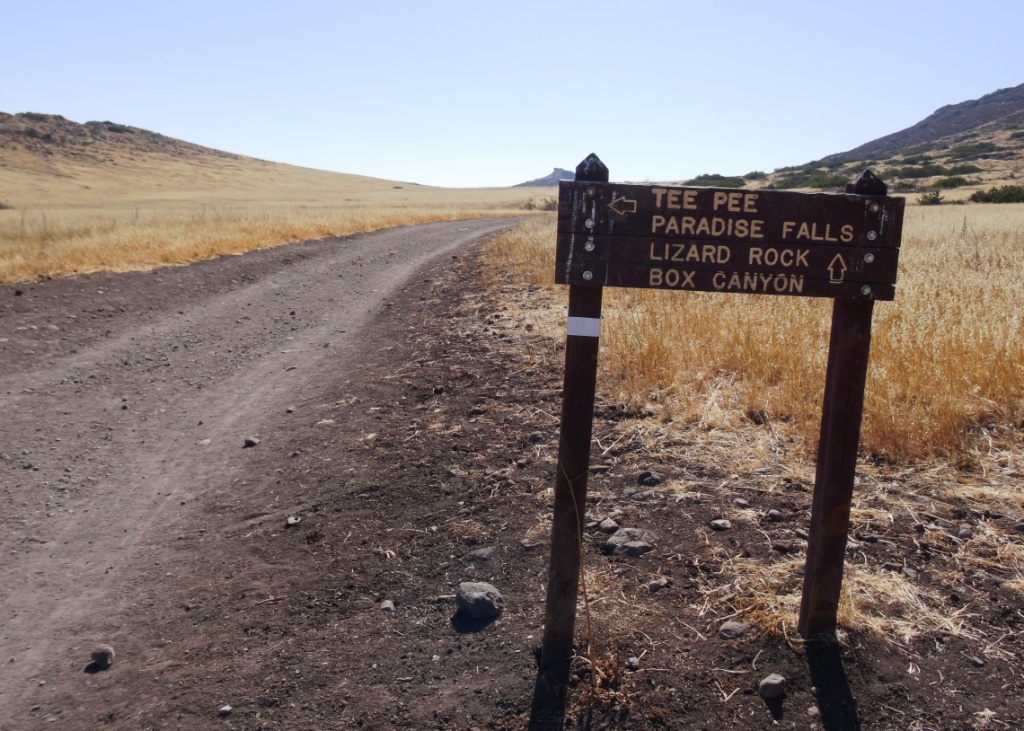
One particularly fun and fairly easy family hike at Wildwood takes you from the main parking lot at the west end of Avenida de los Arboles to the Teepee, Paradise Falls and Little Cave (formerly Indian Cave**). Take the Mesa Trail about a 3rd of a mile until you see the sign below, then take a left.

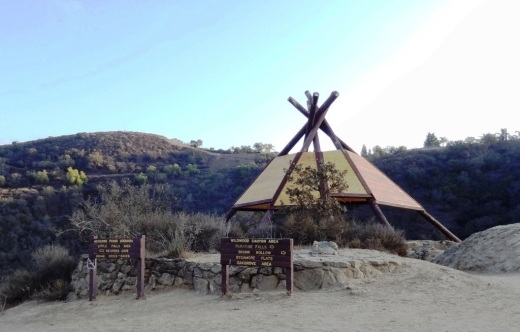
Another third of a mile and you're at the teepee, where you'll find another clearly marked sign pointing you in the direction of Paradise Falls.

Another third of a mile and you're at the teepee, where you'll find another clearly marked sign pointing you in the direction of Paradise Falls.

WildwoodTeepee3.JPG

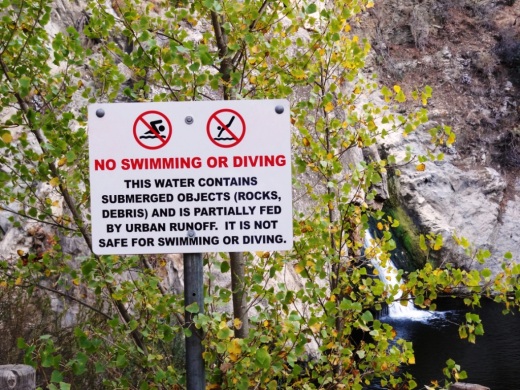
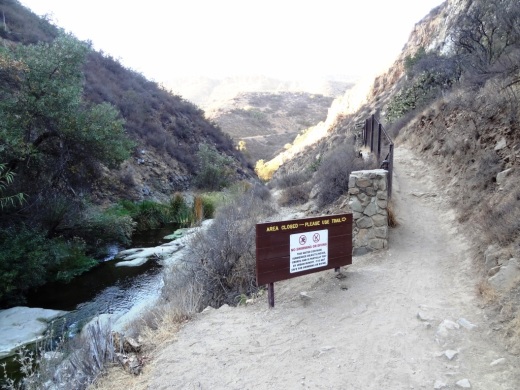
Hike down some switchbacks and stairs and you'll see be at the beautiful Paradise Falls. Always a fun place to take the kids, though we're warned not to go into the water, which is largely urban runoff.

ParadiseFalls2.JPG
ParadiseFalls4.jpg

But it is sure popular and enjoyable to sit back and enjoy this year-round waterfall that is so nicely hidden yet so close to hustle and bustle of suburban Thousand Oaks.

ParadiseFalls11.3.13.JPG

The Little Cave is roughly half a mile east of Paradise Falls and can be accessed from the trail directly above the falls or by hiking back up to the teepee and going the other direction.

Trail adjacent to Paradise Falls that takes you towards the Indian Cave.

Trail adjacent to Paradise Falls that takes you towards little Cave.

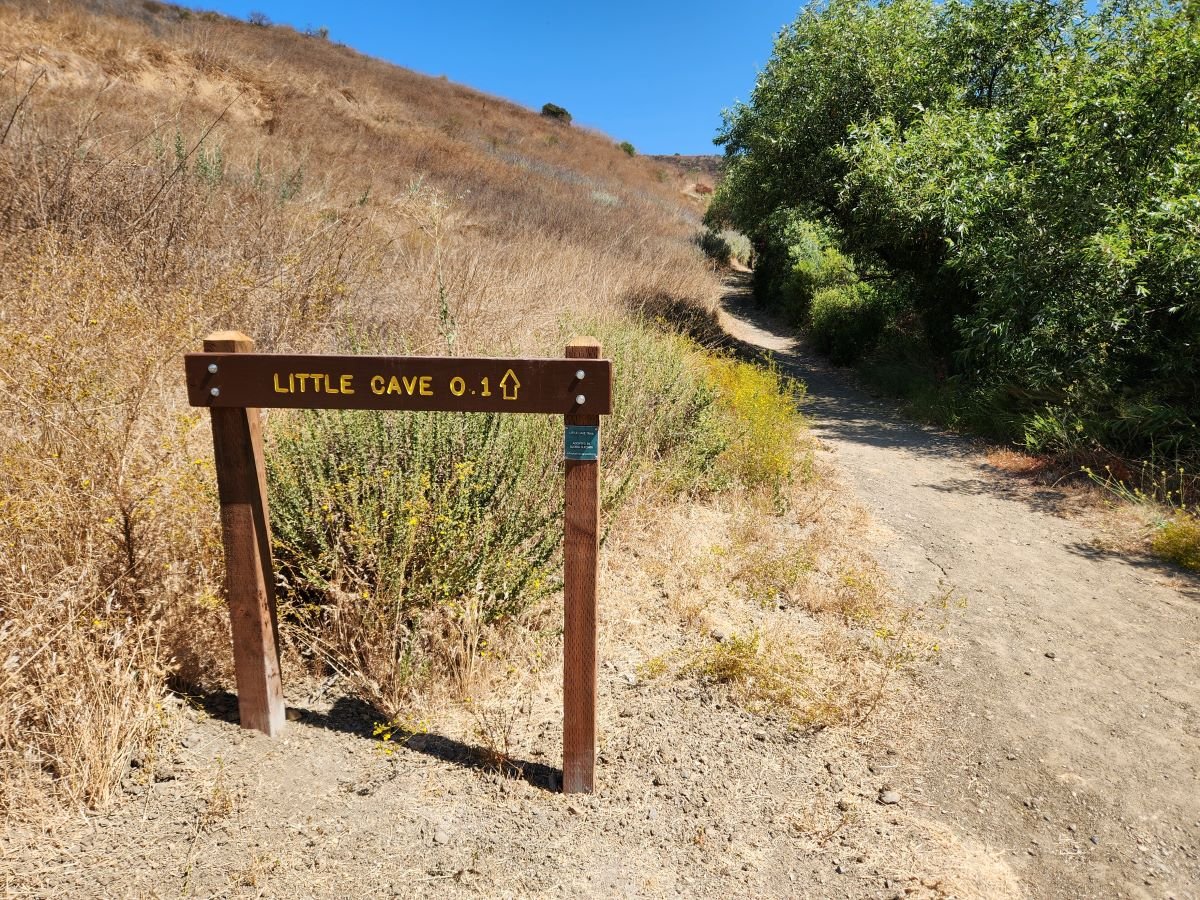
A quarter of a mile or so and you'll see the sign below.

Little Cave (Formerly Indian Cave) sign

Here's the sign indicating you are near the Indian Cave in Wildwood Park.

Formerly called indian cave

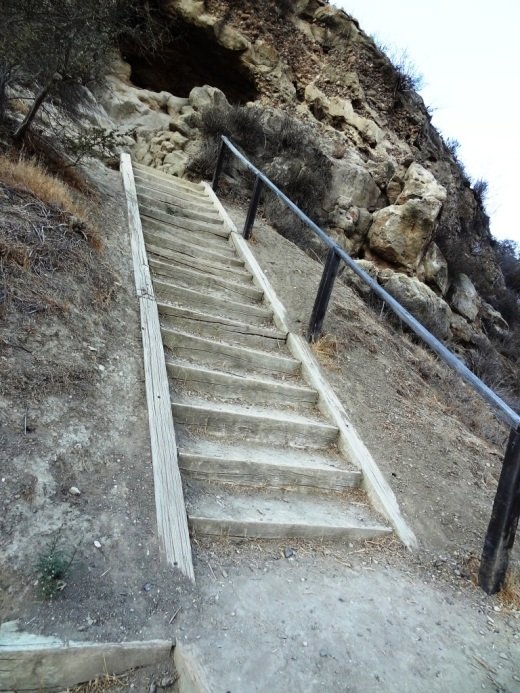
Another 100 yards or so and you've reached the staircase that will take you up to the Cave.

Large enough to actually hang out in, though the last time we walked in there were signs of rodents.

Large enough to actually hang out in, though the last time we walked in there were signs of rodents.

IndianCave5.JPG

You can literally climb through the cave to an exit at the top and hike your way up to a connector trail that will lead you back towards the parking lot. My kids love this and so do I!

** The change in name was approved by the Conejo Open Space Conservation Agency (COSCA) in May 2022. COSCA received a request to change the Indian Creek Trail name earlier that year. On its own, the work "Indian" refers to individuals from India, rather than Native Americans, and thus did not accurately reflect the origin of the people to whom it refers.

The Indian Cave and Indian Cave Trail were renamed Little Cave as it was unclear if the cave was naturally formed and/or historically used by Native Americans.

The Indian Creek Trail in Wildwood Park was renamed Two Springs Trail as two natural springs contribute to the stream flow in this portion of the channel.

The Hunt Olive Tree in Thousand Oaks is a Living Link to Conejo Valley History

Richard Orville Hunt and his wife Mary Jane purchased a large parcel of land in the Conejo Valley in 1876 in what is now Lynn Ranch. He called it Salto Ranch. Hunt also served as postmaster of the Newbury Park Post Office for 18 years and was well known in the local community. While his former land now is populated with family homes, one part of Hunt's ranch lives on.

HuntOliveTreeSprouts2013_2.JPG

For those of you who drive past the Sprouts Market at 600 West Hillcrest, perhaps you have noticed the historic landmark marker situated in front of the last remaining olive tree from Hunt's orchard. The Hunt Olive Tree was designated a Ventura County Historic Landmark in 1981, when the tree was over 100 years old. That would make this olive tree over 130 years old today.

HuntOliveTreeSprouts2013.JPG
HuntOliveTreeCCSign.jpg

For nostalgia buffs, to the right is a view of the Hunt Olive Tree marker back in the day that Circuit City was located here. It closed in late 2008. This tree was moved to its current home in 1993. I'm not sure why...perhaps to say hello to the thousands of residents who pass by each day. What a fine specimen this link to the past is. The Hunt Olive Tree is also Historical Landmark #4 in the City of Thousand Oaks.

So be sure to say hello to this tree that sits next to the Sprouts Farmers Market sign at Hillcrest and Lynn and do be nice to him (or her). She's older and wiser than all of us combined, having seen and lived through the growth of our local community.

Tell Me a Little Bit About Newbury Park

Newbury Park is a community located in the western portion of Thousand Oaks. Most of Newbury Park became part of Thousand Oaks by community vote sometime in the 1960s and 1970s. Thousand Oaks became a city in October 1964.

A view of Newbury Park from Boney Peak in October 2021. (Feet Model: Conejo Joe)

Egbert Starr Newbury (Photo Courtesy Conejo Valley Historical Society)

Egbert Starr Newbury (Photo Courtesy Conejo Valley Historical Society)

Newbury Park is named after Egbert Starr Newbury, who owned thousands of acres of land in the Conejo Valley after moving to California from Michigan for health reasons in 1871.  Newbury was one of the three largest Conejo Valley landowners of his time. He and his wife Fannie became the first postmasters in the Conejo Valley in 1875.  The post office was located in a small compound near their house, which was located at the current location of the Thousand Oaks Civic Arts Plaza

The other major landowners at that time were John Edwards, who owned much of the current Newbury Park/Thousand Oaks area north of the 101, and Howard Mills, who owned much of what today is Westlake Village and Hidden Valley.

Edwards sold 10,000 acres of what is now central Thousand Oaks to Edwin and Harold Janss in 1893.  The Janss Corporation also bought thousands of acres of land in Newbury Park (Friedrich, Running Springs and Borchard Ranches) in 1962. 

There were efforts to incorporate Newbury Park in 1961 and 1963 that failed due to a lack of sufficient votes.

Over a 30 month period beginning in the Fall of 1876, only 6 inches of rain fell in the Conejo Valley.  This drought brought devastation to landowners, most of whom lost their crops and livestock and had to sell at a loss or went bankrupt.  The Newburys were no exception; they moved back to the midwest in 1877.  Egbert fell ill to pneumonia in 1880 and passed away at the young age of 36.

The Newburys lived here only six years, so why is it still called Newbury Park? Because the name of the Newburys' post office never changed! The Newbury Park Post Office has changed locations a number of times (including 1602 Newbury Road from May 1968 until it moved to its current location at 3401 Grande Vista Drive in 2013). So the Newbury name and legacy live on here in the Conejo Valley.

Horse tied to a sign indicating the Newbury Park Post Office, in 1909. The location was near modern-day Lynn Ranch. (Courtesy of the Thousand Oaks Library Local History Photo Collection).

Horse tied to a sign indicating the Newbury Park Post Office, in 1909. The location was near modern-day Lynn Ranch. (Courtesy of the Thousand Oaks Library Local History Photo Collection).

Sources: "The Conejo Valley - Old and New Frontiers" by Carol A. Bidwell and "The Newburys of Newbury Park" by Miriam Sprankling

But wait...there's more to Newbury Park! Casa Conejo is also part of the Newbury Park community but is not an incorporated part of Thousand Oaks. It is considered a census-designated place in Ventura County, with its own Municipal Advisory Council. Casa Conejo is the first planned community in Newbury Park and was built in the early 1960s. It has an area of .5 square mile and is bound by Borchard to the south, Old Conejo Road to the north, Jenny Drive (east of Newbury Park High School) to the west and Sequoia Middle School to the east.

TELL ME ABOUT THE HISTORY OF THE STREET NAMES IN THE CASA CONEJO NEIGHBORHOOD

Interested in historical pictures of the area going back to the 1950s?  Click here to read about the work of prolific Conejo Valley photographer, Ed Lawrence. 

Click here for a history of Thousand Oaks. Thousand Oaks is over 56 square miles and Newbury Park represents about 40% of that square footage. Thousand Oaks was incorporated as a city on October 7, 1964.

Three dozen or so things to do in Newbury Park

Another three dozen or so kids' activities in Newbury Park

Yet another three dozen or so sports and fitness activities in Newbury Park

Century Lake at Malibu Creek State Park

According to the Malibu Creek Docents, around 1903, the Crags Country Club constructed a 50 foot tall dam on its 2,000 acre property on what is now Malibu Creek State Park. The dam created a seven acre lake that club members used for fishing and duck hunting.

The Club closed in 1936, and 10 years later, 20th Century Fox Studios purchased the property to film movies and TV shows on what was renamed Century Ranch. The 1968 "Planet of the Apes" featured many prominent scenes shot here.

This is an awesome video showing Planet of the Apes (1968) film scenes at Malibu Creek State Park and local area beaches then and today.

As for the lake, it is now referred to as Century Lake, a hiking destination in Malibu Creek State Park. Only 1 1/2 miles from the parking area, Century Lake is in a secluded area, where you can eat your lunch at the picnic table and enjoy serenity (usually, depending on who else is there). I believe it is fine to wade in the water and even kayak in there if desired. although I've never seen anyone do so.

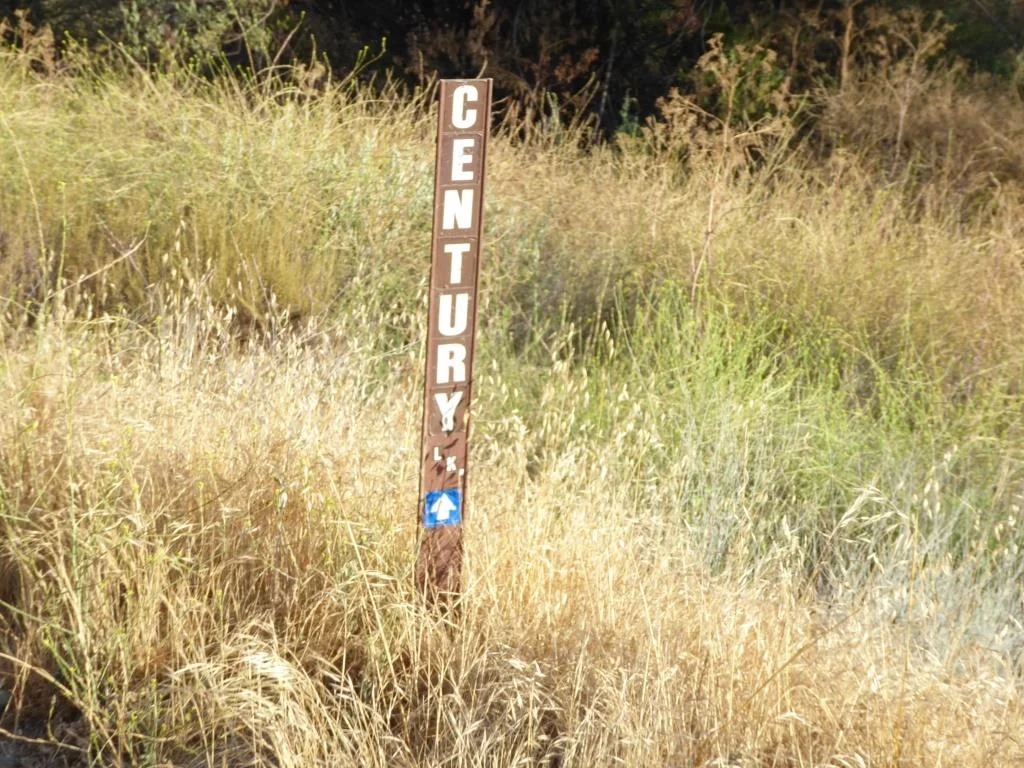
Century Lake is a left hand turn from the main Crags Road trail, after cresting the only significant hill going down the other side. The only indicator is this narrow sign.

Century Lake is a left hand turn from the main Crags Road trail, after cresting the only significant hill going down the other side. The only indicator is this narrow sign.

The hike has a moderately steep hill in it, but otherwise is quite flat and easy to do with kids and/or a stroller.

Malibu Creek State Park has something for everyone...camping, a visitor center, the "Rock Pool," the M*A*S*H set, the old Reagan Ranch, Century Lake, over 35 miles of trails, rock climbing (near the Rock Pool) and more.

The Century Dam is shown in this image. You don't wanna fall down that dam. Off limits.

The Century Dam is shown in this image. You don't wanna fall down that dam. Off limits.

Oakbrook Regional Park Archaeological Area in Thousand Oaks is City Historical Landmark #5

Oakbrook Regional Park Archaeological Area is located at 3290 Lang Ranch Parkway in Thousand Oaks, south of the intersection of Avenida de los Arboles and Westlake Boulevard.

This 428 acre park is a designated historical landmark by the City of Thousand Oaks and County of Ventura. The Chumash inhabited this area going back as far as 12,000 years ago through the late 1800's. 

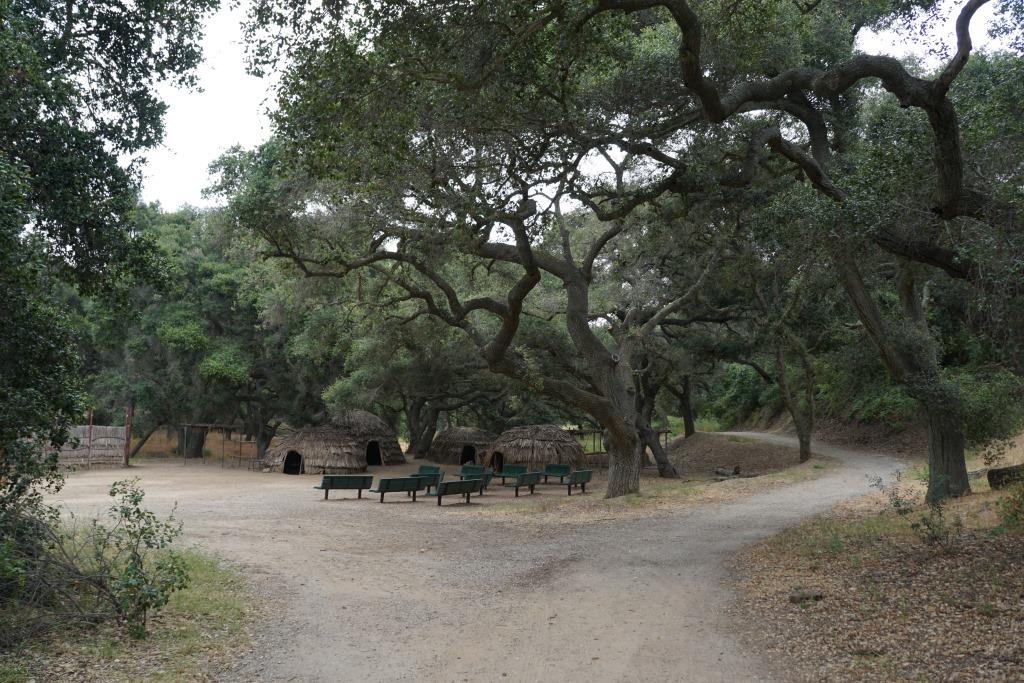
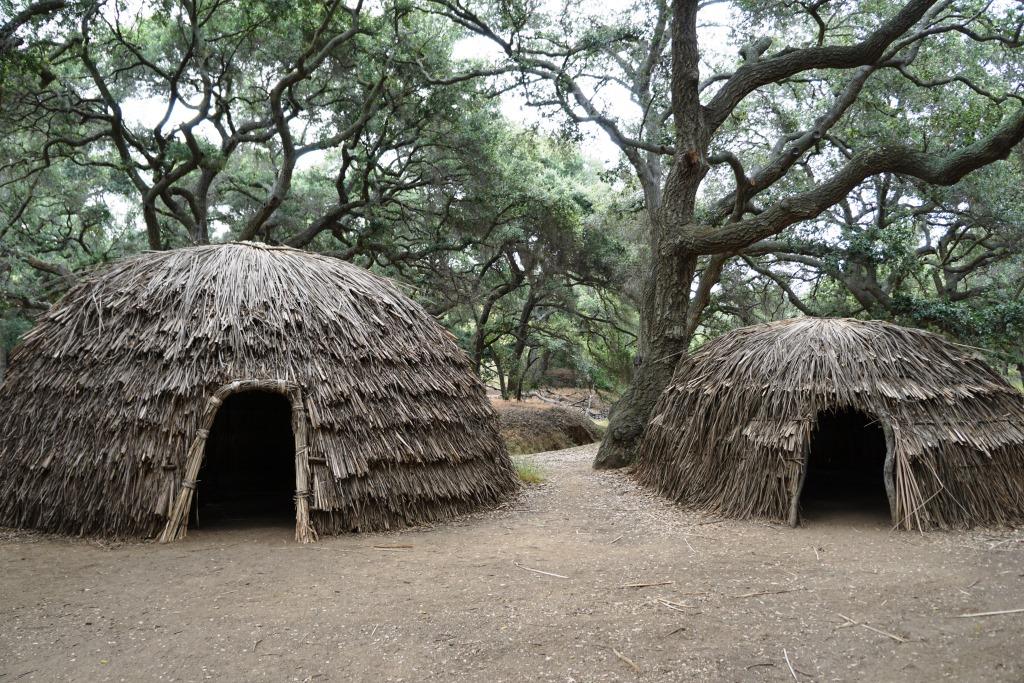
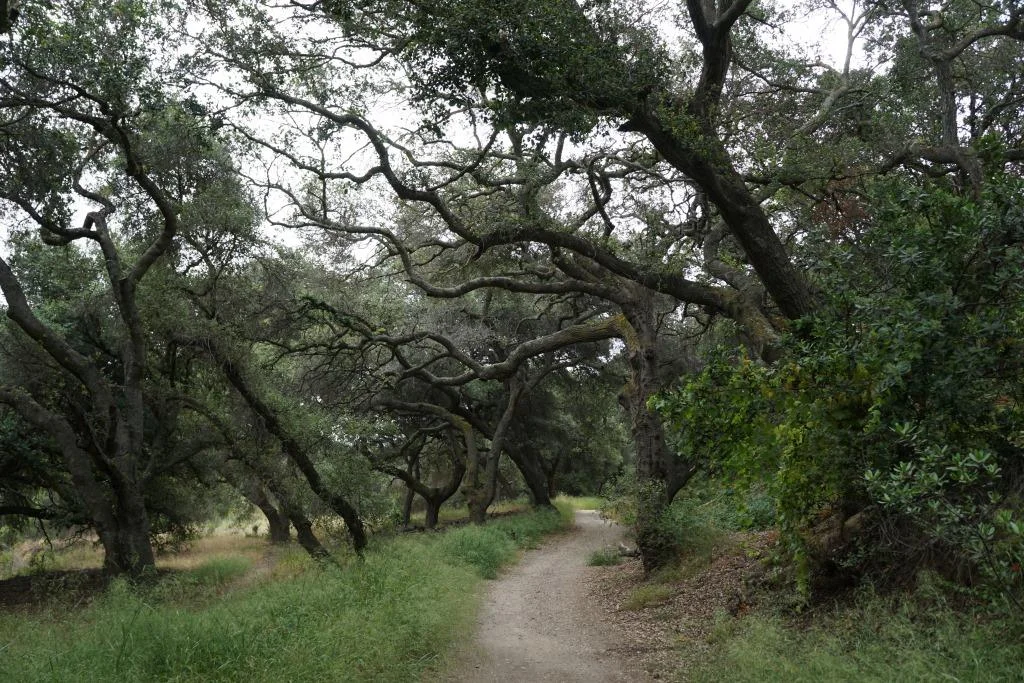
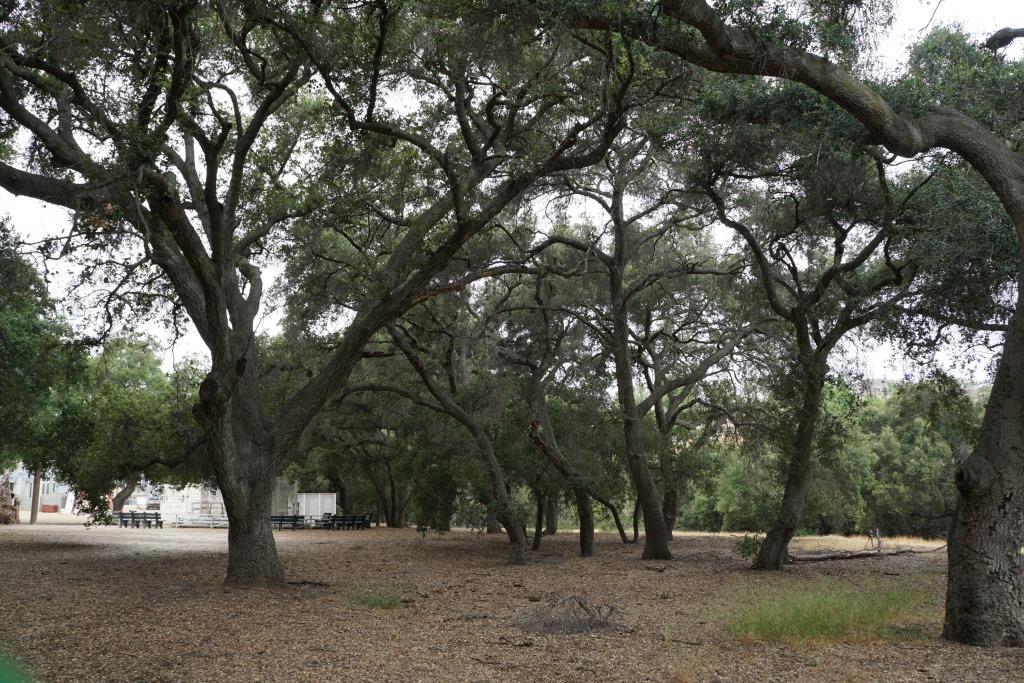
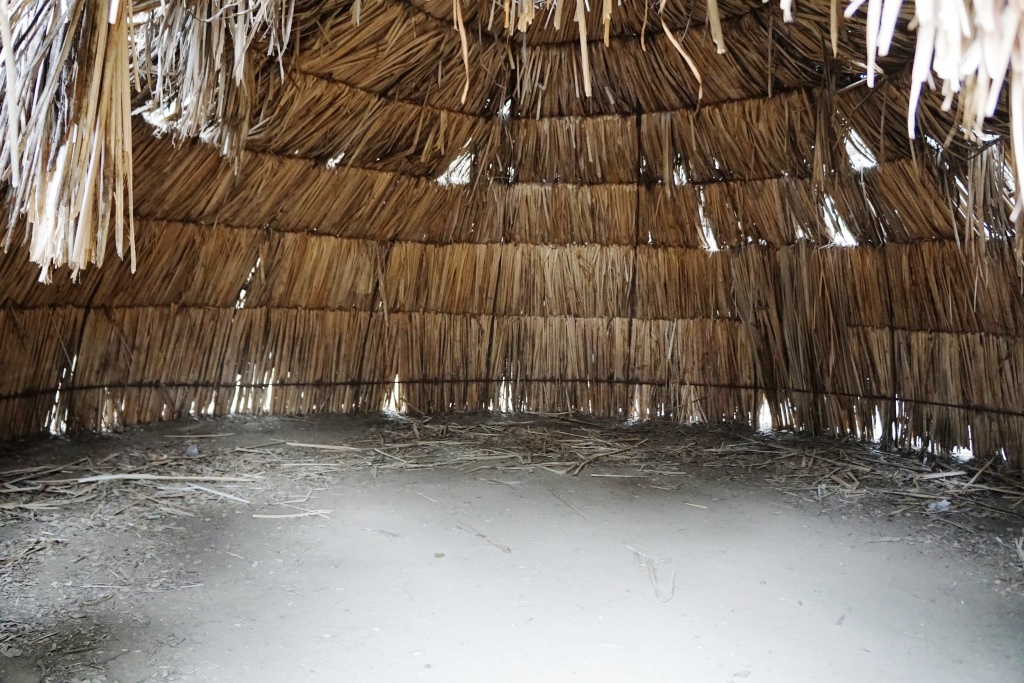
The park grounds are open to the public daily from 7 a.m. to 10 p.m.  There are flat hiking trails and a Chumash village reproduction available to explore. The oak trees provide a beautiful canopy for hikers. It is a peaceful place worth exploring. Note that dogs are prohibited from the property.

Located on the property is the Chumash Indian Museum, which contains a large collection of Chumash artifacts. The museum is open on Saturdays and Sundays from 10 a.m. to 4 p.m.

More information on Oakbrook Regional Park at www.crpd.org/park/oakbrook-regional-park.