Titanic Exhibit at the Reagan Library May 27, 2017 to January 7, 2018

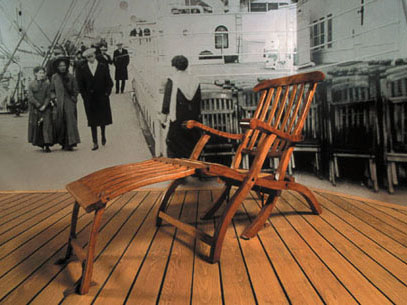
Original deck chair from the Titanic

Original deck chair from the Titanic

Titanic at the Reagan Library is a fascinating look at Titanic, combining real artifacts with the real stories of the people on board the ill-fated ship. This new exhibit tells the story of the unsinkable ship in a way no museum has done before. Artifacts from passengers, dispersed over time, will be reunited in this exhibit for the first time in over 100 years.

This brand-new 10,000 square foot exhibition, reuniting hundreds of Titanic artifacts that have not been together since the ship’s fateful night in 1912 with material and artifacts from the 1984-1985 discovery of the Titanic as well as with items from the 1997 movie, is a first-of-its-kind exhibition not seen anywhere else before. The exhibition was made possible through the generous support and assistance of Woods Hole Oceanographic Institution, Cedar Bay Entertainment, parent company of The Titanic Museums of Pigeon Forge, TN and Branson, MO, and Lightstorm Entertainment/20th Century Fox.

Found in 1985 during President Reagan’s administration, the Titanic quickly became a dive site for many different companies and explorers trying to get a piece of her history.  To protect the historic site and preserve it for generations, President Reagan issued the 1986 RMS Titanic Memorial Act to designate the wreck as an international maritime memorial.

None of the artifacts displayed in this exhibition were salvaged from the wreck itself – a sacred final resting place.

A historic collection of real artifacts from the Titanic alongside items used in the discovery of the famed ship, Titanic at the Reagan Library combines real stories and real artifacts from the real people onboard the ship. Dramatically set with props, sets and costumes from the blockbuster movie about the RMS Titanic, it is a must-see collaboration of secrets, cinema and artifacts!

Highlights include:

  • “Alvin” – the titanium submersible sphere that brought Dr. Bob Ballard down to the wreckage of Titanic; the first such submersible to do so
  • Sheet music for “Narcissus” which was found on the body of Wallace Hartley, the Titanic’s bandleader who refused to stop playing, even as the ship began to sink
  • A deck chair from the Titanic, one of only eight known to exist, as well as the only known “widow’s seat” deck chair from the Carpathia
  • The only known complete set of boarding documents and tickets from the Titanic
  • John Jacob Astor IV’s pocket watch, found on his body days after the Titanic sank, and his wife’s life vest she wore to her safety
  • The claim form from Margaret Brown (otherwise known as “The Unsinkable Molly Brown”) and the Egyptian Talisman she carried off the ship
  • Marion Wright Woolcott’s wool coat; the one she wore when she escaped in lifeboat 9, then later wore to her wedding; then later cut strips of fabric from to make Bible covers for her three sons as they served overseas
  • Pocket watch and pocket knife recovered from the body of Oscar Woody, one of the five mail clerks onboard the Royal Mail Ship (RMS) Titanic
  • Original film footage of the Titanic’s maiden voyage and the Mackay-Bennett’s recovery mission
  • Movie sets, props and costumes from the blockbuster movie about the RMS Titanic, including a full-size life boat and Rose and Cal’s Suite
  • And so much more

This is not a traveling exhibition.  To see the story of the Titanic told in such a unique way, visitors must come to the Reagan Library.  Whether you are a fan of genuine history or larger-than-life Hollywood, this is truly an once-in-a-lifetime exhibition that sheds light on the Titanic in a first-ever way no museum has attempted before!

Learn more at www.reaganfoundation.org.

Views in 1957 Looking East From Lynn and Gainsborough Roads in Thousand Oaks

7254 Thousand Oaks 1957 Venturaviews.jpg

Steve Dibblee provided this shot taken by his father, Walt Dibblee, from the mountain ridge at the northwest corner of what is now Lynn Road and Gainsborough Road in Thousand Oaks sometime in the year 1957, seven years before the city was incorporated. This ridge is just southwest of nearby Tarantula Hill and the shot is facing east. So how about comparing it to a few recent shots looking east from Tarantula Hill.

Taran1.JPG
Taran2.JPG

I see a lot of oak trees and clouds in all of the photos but...just a wee bit more other things, like houses, roads, cars and such in the more recent pictures. :)

See more of Dibblee's photographs from the mid 1950s to the late 1960s at VenturaViews.com where you also have the option of acquiring high-resolution prints of these blasts to the past. Thanks to Steve Dibblee for sharing some of his late father's work with us here on Conejo Valley Guide and at www.facebook.com/ConejoValleyGuide.

The Smallest Post Office in the United States Used to Be in Wheeler Springs, Near Ojai

We were in Ojai for some activities and decided to drive up Maricopa Highway to check out the Wheeler Gorge Visitor Center for the first time. It is a cute little building that provides information about the Los Padres National Forest staffed with volunteers who sell maps, trail guides, Adventure Passes and other items. Located at 17017 Maricopa Highway, about eight miles from the "Y" intersection where if you continue right you are headed into Ojai. The Wheeler Gorge Campground is nearby.

More on local campgrounds in and around Ventura County at THIS LINK.

More on local campgrounds in and around Ventura County at THIS LINK.

About a mile and a half before reaching the Visitor Center, at 16850 Maricopa Highway, we stopped at a small structure, shown above, that says "U.S.A.'s Smallest Post Office - Wheeler Springs, California."

There's quite a bit of history behind that structure and others in the area. According to OjaiHistory.com, the Wheeler Springs Post Office was installed by Webb Wilcox next to his Webb Wilcox Cafe in the mid-1930s after the Maricopa Highway was built, connecting Ojai to Kern County. The "glorified shack" was was designated by Ripley's Believe it or Not as the smallest Post Office in the U.S.A. until Wilcox died in 1962 and Wheeler Springs lost its status as a U.S. Post Office.

Webb Wilcox was the son-in-law of Wheeler Blumberg, who founded Wheeler's Hot Springs in 1891. Wheeler's Hot Spring Springs for awhile was a successful resort, with 14 guest cabins, swimming pool, fishing, camping, hot springs-fed swimming pool and more.

Blumberg went a bit crazy in May 1907, locking himself in a room and shooting holes through the walls. A posse was able to capture Blumberg, sedate him and place him in a straitjacket in a padded cell in Ventura. He continued screaming and straining until he died "from utter exhaustion" the next day at age 43. Wilcox, who previously married Blumberg's daughter, Etta, took control over the resort and renamed it Wheeler Hot Springs.

Wheeler Hot Springs went through a number of ownership changes over the years, including radio/TV personality Art Linkletter at one point, who opened a "Kiddie Land" attraction, who did not do well financially there. Over the decades, the resort survived and was rebuilt after multiple fires, and the "great flood of '69" but finally was completely closed down in 1999.

Visit THIS LINK on the OjaiHistory.com website for a much more detailed, fascinating account of Wheeler Hot Springs' ownership challenges over the years..

The Wheeler Hot Springs property is located at 16825 Maricopa Highway and according to Zillow.com was most recently sold in October 2016. It is privately owned and not open to the public but you will get a small glimpse of it as you drive by. According to the Zillow listing, Wheeler Hot Springs is 84.5 acres and has five known natural hot and cold mineral springs and a year-round creek. There is a large farmhouse occupying the center of the property.

Statue in Recognition of CLU Football Founding Father Bob Shoup at William Rolland Stadium

Many if not most residents of Thousand Oaks will visit California Lutheran University from time to time, be it for events open to the public at the university, sporting event, a visit to the William Rolland Gallery of Fine Art, the community pool at Samuelson Aquatics Center, or Gilbert Sports and Fitness Center, or just a walk around the campus.

Next to the Rolland Gallery in University Plaza is a statue dedicated to Bob Shoup, the founding father of CLU football. The bronze statue, "Champions," was unveiled on October 18, 2014 in homage to Shoup's Kingsmen football team that won the National Association of Intercollegiate Athletics (NAIA) Championship in 1971.

Bob Shoup was CLU football coach from 1962 to 1989 as well as Athletic Director from 1969 to 1977. He was inducted into the NAIA 2008-2009 Hall of Fame. Shoup now lives in San Marcos, California.

Pacific Coast Highway Was Originally Called the Roosevelt Highway

The 1400 mile stretch of road called the Roosevelt Highway (U.S. 101) in the 1920s was re-named Pacific Coast Highway in 1941.

This postcard, from back in the days when it cost only a penny to mail a postcard (the 1930s) indicates "the varying scenery, such as oil being drilled out of the ocean, makes motoring an interesting pastime in California." It shows an image of the Roosevelt Highway between Ventura and Santa Barbara.

Bob then indicates to his dear friend Jane, "Just dropping a line to say all is well in Calif. There's lots of strange things to see in this state. You should be taking your Sunday rides out here."

Now what does Bob mean by that? Well, never mind. Speaking of Ventura and Santa Barbara beaches, visit THIS LINK for public beaches spanning from the Ventura Harbor through Carpinteria and THIS LINK for Santa Barbara area beaches.

Rare Images of Ventura County History on Display at CSUCI Beginning January 26th

Ladies in feathered hats boarding the first train from Oxnard to Hueneme; a Model T Ford clattering through a beet field and the opening ceremony for the Conejo Grade are some of the images available in a newly-digitized collection at CSU Channel Islands’ John Spoor Broome Library.

About 40 historic photos of Ventura County from the collection will be on display in the John Spoor Broome Library art gallery beginning Jan. 26 in “Ventura County: Places, Voices and Histories,” a series of photographs, penny post cards, and posters that show Ventura County over the last 100 or so years.

The opening for the exhibit will be Thursday Jan. 26 from 5 to 6:30 p.m. in the gallery at One University Drive in Camarillo.

Professor of Art and Broome Gallery coordinator Irina D. Costache, Ph.D., curated the show, which is organized in collaboration with CSUCI’s Head of Unique Collections Matt Cook and Professor of Chicana/o Studies Jose Alamillo, Ph.D.

The show will be organized into sections that highlight different aspects of Ventura County’s history such as cars and roads, people, places, fields and farms.

Historic “voices” in the show will be in the form of a video of Ventura County’s “braceros,” a term to describe Mexican laborers who worked in the fields on a seasonal basis. 

Cook said it took staff and student volunteers several years to digitize all 1500 images in the collection, much of which was housed at the E.P. Foster Library in Ventura.

Limited parking is available on campus with the purchase of a $6 daily permit; follow signs to the parking permit dispensers. Free parking is available at the Camarillo Metrolink Station/Lewis Road with bus service to and from the campus. Riders should board the CSUCI Vista Bus to the campus; the cash-only fare is $1.25 each way. Buses arrive and depart from the Camarillo Metrolink Station every 30 minutes from 7 a.m. to 10 p.m. Monday through Friday. For exact times, check the schedule at www.goventura.org.

About California State University Channel Islands
CSU Channel Islands (CSUCI) is the only four-year, public university in Ventura County and is known for its interdisciplinary, multicultural and international perspectives, and its emphasis on experiential and service learning. CSUCI’s strong academic programs focus on business, sciences, liberal studies, teaching credentials, and innovative master’s degrees. Students benefit from individual attention, up-to-date technology, and classroom instruction augmented by outstanding faculty research. CSUCI has been designated by the U.S. Department of Education as a Hispanic-Serving Institution and is committed to serving students of all backgrounds from the region and beyond. Connect with and learn more by visiting CSUCI’s Social Media.

Dorothy's Chuck Wagon Cafe Captured in Oil Painting by Local Artist, Linda Dark

2022 Update: Dorothy’s Chuck Wagon Cafe closed in June. The building was sold.

Dorothy's Chuck Wagon Cafe is located in Old Town Camarillo at 2344 Ventura Boulevard, serving home-style breakfast and lunch Monday through Saturday. Their phone number is 805.987.2167.

Linda Dark is an artist has lived in Camarillo since 1978. She enjoys capturing local landmarks in oil on canvas, including her latest work piece above. Check out her work at www.camarillolandmarks.com.

The Chuck Wagon Cafe has been here for quite some time. According to the Pleasant Valley Historical Society, the building was built in 1944 and was owned by Larry Logue, who opened Larry's Malt Shop in 1946. It soon became Carmen's Snack Bar, owned by Ed and Carmen Quinn. Dorothy Johnson took over as new owner in 1983.

OldestRestaurants.com has a compilation of the oldest restaurants that are still in operation at the same location in California. Dorothy's Chuck Wagon Cafe is one of the oldest eateries in Ventura County, following the Golden Chicken Inn in Oxnard (the oldest still standing restaurant in Ventura County; founded in 1929) and Familia Diaz in Santa Paula (1936).

Also on that list as opening in 1946 are Casa Escobar (which closed its Westlake Village location last Fall) and El Tecolote in Camarillo.

A more recent view of Dorothy's Chuck Wagon Cafe.

A more recent view of Dorothy's Chuck Wagon Cafe.