New Thousand Oaks The Habit Burger Grill Continues This Burger Chain's Success Story

The Habit Burger Grill originated on November 15, 1969 at 5735 Hollister Ave, Goleta - a location that is still in operation to this day. The Habit is a fast casual restaurant concept that specializes in preparing fresh, made-to-order char-grilled burgers and sandwiches featuring USDA choice tri-tip steak, grilled chicken and sushi-grade albacore tuna cooked over an open flame. 

The chain was purchased by a private equity firm in 2007 and subsequently The Habit Restaurants, Inc. went public with an initial stock offering on November 19, 2014, 45 years after its inception.

The new location coming soon to Thousand Oaks. Ever wonder why the "b" in Habit is slightly twisted? I asked. The Habit indicates it "makes it special and light hearted."

The new location coming soon to Thousand Oaks. Ever wonder why the "b" in Habit is slightly twisted? I asked. The Habit indicates it "makes it special and light hearted."

A new location is coming to Thousand Oaks at the former Famous Dave's BBQ location at 3980 Thousand Oaks Blvd. This will mark the 4th Conejo Valley Habit Burger location, including existing locations in Thousand Oaks, Newbury Park and Agoura Hills. Additional Ventura County locations in Simi Valley (2), Camarillo, Oxnard and Ventura (2).

The Habit trades under stock symbol HABT and currently is (as of December 20, 2016) at $17.30 per share, down 4% from its initial public offering price of $18 per share. That said, its price soared to close at nearly $40 per share that first day of trading, making it a bit of a terrible investment for those that bought after the IPO.

Stock price aside, The Habit has been quite a success story, growing to 160 restaurants in 10 states and opening new restaurants at the rate of over 30 per year. Total revenue for The Habit's fiscal year 2016 is anticipated to be in the $283 million range.

Photo courtesy of The Habit Burger. While my Habit Burger doesn't look quite this perfect, that's no big deal. It usually reaches my mouth before my eyes have much time to admire it.

Photo courtesy of The Habit Burger. While my Habit Burger doesn't look quite this perfect, that's no big deal. It usually reaches my mouth before my eyes have much time to admire it.

But back to stock price. For a growth stock like The Habit, timing can be critical. Let's look at an example. Over the last two years ending today, had you purchased $100 in McDonald's stock (MCD), the value of that investment today would be $131, and you would have received cash dividends of close to $8, for a total return of 39%. $100 invested in HABT would now be worth about $52. 

So while The Habit Burger may have been rated #1 burger in a 2014 Consumer Reports survey (and I for thoroughly enjoy the burgers and other menu items at The Habit), you don't necessarily always want to put your money where you mouth is. Or your mouth where your money is, for that matter.

To learn more about The Habit, visit www.habitburger.com.

La Conchita, Located on Western End of Ventura County

La Conchita is an unincorporated, beachside community of about 300 residents in the westernmost section of Ventura County.

We all pass by La Conchita as take the 101 to Santa Barbara. From time to time, though we pull off the 101 at Santa Barbara Avenue, where we are promptly "greeted" by the sign shown below after crossing the railroad tracks.

The WARNING sign indicates "The La Conchita Community is a geologic hazard area. County officials advise against entry into the hazard area. Based on the present information known about ancient landslides and the 1995 and 2005 landslides, the following geological hazards are present:

  1. Catastrophic Failure: The large ancient landslide mass located above the Community could potentially fail, impacting residences within the Community AT ANY TIME AND WITHOUT WARNING.
  2. Mudflows: Mudflows could potentially impact all residences and access roads within the Community.
  3. Catastrophic Failure and Mudflows: Should both events occur simultaneously, the Community could be impacted.
  4. No excavation (removal of earth material) or grading should be performed in the Community without recommendations from a geologist and/or geotechnical engineer and review by the County of Ventura, Public Works Agency.

THERE IS NO WARNING SYSTEM FOR THESE HAZARDS. ENTER AT YOUR OWN RISK.

What prompted this dire warning is what happened on January 10, 2005. After 26 inches of rain poured in 16 days in the area, 400,000 tons of mud slid down the bluff above La Conchita, taking the lives of 10 residents, destroying 13 homes and seriously damaging 23 others.

Preceding the 2005 landslide were landslides in 1995 that demolished 14 homes (no lives were lost). Experts indicate that landslides have taken place here for quite a long time.

The community of La Conchita (Spanish for little conch shell) was first established in 1924 with the creation of 200 mostly single family residences.  It is a beautiful little beach community with quick access to the beach via a tunnel under the 101. I can see what keeps folks here. But let's hope that if and when additional landslides take place, the remaining homes are not impacted.

Reference: U.S. Geologic Survey Report "Landslide Hazards at La Conchita, California"

History on Display at the Channel Islands Maritime Museum in Oxnard

Located in the Channel Islands Harbor next to The Whales Tail Bar & Grill, the Channel Islands Maritime Museum houses an outstanding collection of maritime art, objects and unique ship models.

CIMM_front.JPG

The Museum is home to a permanent collection of extensive marine art, featuring works by 17th century Dutch and Flemish artists Willem van de Velde and Bonaventura Peeters. Noted modern artists in the collection include John Stobart, Montague Dawson, David Thimgan, Roy Cross and Christopher Blossom.

CIMM_ship2.JPG

The museum houses one of the two largest collections of antique Napoleonic prisoner of war sailing ship models in the country. Three thousand years of maritime history are illustrated by historic ship models, including the life's work of renowned builder Edward Marple. Exhibits on whaling, sailors' arts and the history of the Channel Islands Harbor and Port of Hueneme round out the collection.

CIMM_pic.jpg

The Museum also hosts lectures. temporary exhibits, open houses and more.

CIMM_ship2.JPG

The museum is open Thursday to Monday from 11 AM to 5 PM. Admission is $7 for Adults, $5 for Seniors (62+) and $3 for children ages 6 to 17 (as of October 2016). Admission is FREE the 3rd Thursday of each month. For more information, visit www.channelislandsmaritimemuseum.org or call 805.984.6260.

"The Roots of our Lives" Living Time Capsule at Thousand Oaks Civic Arts Plaza

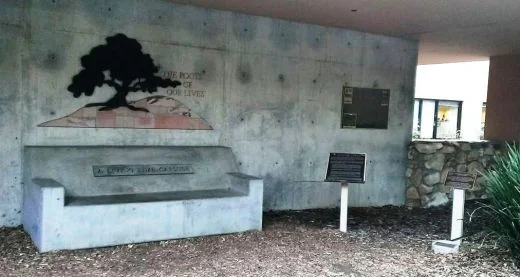
The Roots of our Lives "Living Time Capsule" located at the Thousand Oaks Civic Arts Plaza

The Roots of our Lives "Living Time Capsule" located at the Thousand Oaks Civic Arts Plaza

The City of Thousand Oaks was incorporated in 1964 after a majority vote on September 29, 1964. Thirty years later, City leaders decided to do something very special by creating a "Living Time Capsule" designed to grow over the years.

CivicArtsPlazaCarpenter.jpg

In the front of the Thousand Oaks Civic Arts Plaza, on the east side behind the large Mary and Richard Carpenter Plaza Park sign, is "The Roots of our Lives," an area that contains the living time capsule.  A geocache led us here. Learn more about geocaching at this link.

TimeCapsuleTO_1.jpg

Here is the inscription on a sign next to the "Living Time Capsule" bench:

"A time capsule is encased within the bench below the specially designed oak tree and mountainscape relief with the time capsule theme, "The Roots of our Lives." It is filled with documents and artifacts reflective of the City of Thousand Oaks' rich historical heritage, and current public and private activities.

It is called "A Living Time Capsule" for it was designed to grow as our City grows, with each succeeding generation contributing to the contents of four time capsule containers. This is accomplished through a unique program, whereby:

  • A group of fifty ten year-old children were designated "Guardians of the Time Capsule" at the dedication on October 9, 1994. They will be back for the next opening of the time capsule when a new generation of "Guardians" will be chosen. This process will continue for the next three openings of the time capsule.

  • At its dedication on October 9, 1994, two of the four time capsule containers were filled and sealed.

  • The third container will be filled and sealed at the time capsule's opening on the City's 50th Anniversary, in the year 2014. This process will be repeated with the fourth container, on the City's 75th Anniversary, in the year 2039.

  • A final opening of all four containers will take place on the City's 100th Anniversary, in the year 2064."

TimeCapsuleTO_3.jpg
TimeCapsuleTO_4.jpg

Time Capsule created by the Greater Conejo Valley Chamber of Commerce was buried on November 20, 1989 and will be opened on November 20, 2039. Makes one ponder....will I be around to witness this?

Carpinteria and Indian Village of Mishopshnow California Registered Landmark No. 535

California State Registered Landmark No. 535 is located at the Carpinteria Valley Museum of History as well as at 1000 South Carpinteria Avenue (pictured above).

The landmark was registered on May 31, 1955 as "La Carpinteria" - The Carpenter's Shop.

The Chumash (which means "bead maker") have lived along the California coast for over 13,000 years. The Chumash Indian village of Mishopshnow, discovered by Juan Rodríguez Cabrillo on August 14, 1542, was located 1/4 mile southwest of the monument.

Fray Juan Crespí of the Gaspar de Portolá Expedition named the village San Roque on August 17, 1769. Portolá's soldiers, observing the Indians building wooden canoes, called the village La Carpinteria.

These canoes, or tomol, came in handy for catching fish in deep waters. The advanced design of the tomol utilized the naturally occurring asphalt in the area to seal them. The tar still oozes today at Carpinteria State Beach at Tar Pits Park, one of five natural asphalt lake areas in the world.

Learn more about the Chumash at the Chumash Indian Museum in Thousand Oaks.

Aerial Views of Dos Vientos Ranch in Newbury Park in 1956

Aerial View of Dos Vientos Ranch in 1956 (Photo Credit: Howard D. Kelly, Kelly-Holiday Collection of Negatives and Photographs/Los Angeles Public Library)

Aerial View of Dos Vientos Ranch in 1956 (Photo Credit: Howard D. Kelly, Kelly-Holiday Collection of Negatives and Photographs/Los Angeles Public Library)

According to several Oxnard Press-Courier articles in September/October 1958, evangelist O.L. Jaggers purchased the 5,415 acre Dos Vientos Ranch from M.S. Clark Enterprises on June 21, 1957 for $2.9 million, with the goal of creating the "World Church City."

According to a 1994 L.A. Times article, Jaggers and his wife Velma talked about making Dos Vientos (now part of Newbury Park/Thousand Oaks) a 26,000 resident city, "situated under a perpetually hovering 'glory cloud' that would emit a pillar of smoke by day and fire by night. Airliners would be diverted so passengers could witness the phenomenon."

After years of lawsuits brought against Jagger and his World Church by investors in the project, the land was acquired in 1965 by Louis Lesser Enterprises of Beverly Hills.

Another Aerial View of Dos Vientos Ranch in 1956 (Photo Credit: Howard D. Kelly, Kelly-Holiday Collection of Negatives and Photographs/Los Angeles Public Library)

Another Aerial View of Dos Vientos Ranch in 1956 (Photo Credit: Howard D. Kelly, Kelly-Holiday Collection of Negatives and Photographs/Los Angeles Public Library)

The Thousand Oaks City Council approved development of Dos Vientos Ranch as a 2,350 home residential project in 1988 and construction began after years of planning and lawsuits in 1997. At the time, the land was owned by Courtly Homes Inc. and Operating Engineers Pension Trust Inc.

A 1997 Los Angeles Times article noted that Dos Vientos was the largest residential project ever in Newbury Park and the third-largest in the city's history. Dos Vientos is surrounded by two connecting roads that form a loop: Rancho Dos Vientos and Via Las Brisas. Lynn Road fronts the development on the south and Borchard Road serves as its main artery.

A more recent view of Dos Vientos from one of the many trails surrounding the area.

A more recent view of Dos Vientos from one of the many trails surrounding the area.

There are some nice hiking trails in Dos Vientos, including Sierra Vista Trail, Park View Trail, Vista Del Mar Trail, El Rincon, El Cerro and Las Brisas Trails, El Encanto Trail and Conejo Mountain Edison Road Trail.

Also located in Dos Vientos is The Village at Dos Vientos retail/business center, Dos Vientos Community Park and the newer Del Prado Playfield.

Aerial View of Central Thousand Oaks, Including Tarantula Hill, in 1957

Thousand Oaks 3-24-1957.jpg

Walt Dibblee opened his commercial studio in Ventura in 1949 and as Ventura County grew, the demand for aerial photography expanded. Walt bought a plane, learned to fly and for the next three decades photographed the cities of Ventura County from above.

The 1957 aerial shot above took place on a foggy day and captured Tarantula Hill on the right and what is now Conejo Community Park and the prominent Conejo Valley Botanic Garden hill in the foreground.

While we don't have an aerial shot of this scene from today, here's a look from the Los Robles Trail.

More recent view of Tarantula Hill from the Los Robles Trail East; The Oaks Mall in the foreground.

More recent view of Tarantula Hill from the Los Robles Trail East; The Oaks Mall in the foreground.

Walt's son Steve continues the tradition today with over 30 years of professional experience. Steve has shared some of Walt's work from the mid 1950s to the late 1960s at VenturaViews.com.

See other scenes from the smaller hill near Lynn Road and Gainsborough Road southwest of Tarantula Hill looking east and looking west.