Rare Images of Ventura County History on Display at CSUCI Beginning January 26th

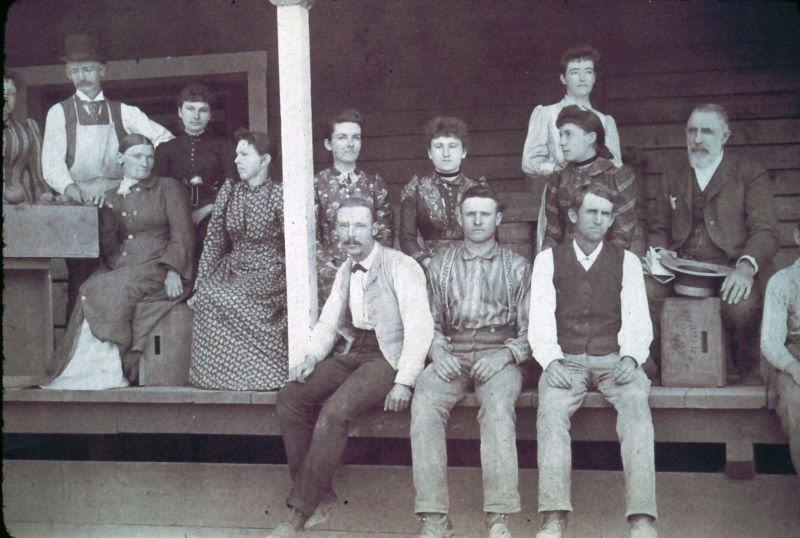
Ladies in feathered hats boarding the first train from Oxnard to Hueneme; a Model T Ford clattering through a beet field and the opening ceremony for the Conejo Grade are some of the images available in a newly-digitized collection at CSU Channel Islands’ John Spoor Broome Library.

About 40 historic photos of Ventura County from the collection will be on display in the John Spoor Broome Library art gallery beginning Jan. 26 in “Ventura County: Places, Voices and Histories,” a series of photographs, penny post cards, and posters that show Ventura County over the last 100 or so years.

The opening for the exhibit will be Thursday Jan. 26 from 5 to 6:30 p.m. in the gallery at One University Drive in Camarillo.

Professor of Art and Broome Gallery coordinator Irina D. Costache, Ph.D., curated the show, which is organized in collaboration with CSUCI’s Head of Unique Collections Matt Cook and Professor of Chicana/o Studies Jose Alamillo, Ph.D.

The show will be organized into sections that highlight different aspects of Ventura County’s history such as cars and roads, people, places, fields and farms.

Historic “voices” in the show will be in the form of a video of Ventura County’s “braceros,” a term to describe Mexican laborers who worked in the fields on a seasonal basis. 

Cook said it took staff and student volunteers several years to digitize all 1500 images in the collection, much of which was housed at the E.P. Foster Library in Ventura.

Limited parking is available on campus with the purchase of a $6 daily permit; follow signs to the parking permit dispensers. Free parking is available at the Camarillo Metrolink Station/Lewis Road with bus service to and from the campus. Riders should board the CSUCI Vista Bus to the campus; the cash-only fare is $1.25 each way. Buses arrive and depart from the Camarillo Metrolink Station every 30 minutes from 7 a.m. to 10 p.m. Monday through Friday. For exact times, check the schedule at www.goventura.org.

About California State University Channel Islands
CSU Channel Islands (CSUCI) is the only four-year, public university in Ventura County and is known for its interdisciplinary, multicultural and international perspectives, and its emphasis on experiential and service learning. CSUCI’s strong academic programs focus on business, sciences, liberal studies, teaching credentials, and innovative master’s degrees. Students benefit from individual attention, up-to-date technology, and classroom instruction augmented by outstanding faculty research. CSUCI has been designated by the U.S. Department of Education as a Hispanic-Serving Institution and is committed to serving students of all backgrounds from the region and beyond. Connect with and learn more by visiting CSUCI’s Social Media.
Dorothy's Chuck Wagon Cafe Captured in Oil Painting by Local Artist, Linda Dark

2022 Update: Dorothy’s Chuck Wagon Cafe closed in June. The building was sold.

Dorothy's Chuck Wagon Cafe is located in Old Town Camarillo at 2344 Ventura Boulevard, serving home-style breakfast and lunch Monday through Saturday. Their phone number is 805.987.2167.

Linda Dark is an artist has lived in Camarillo since 1978. She enjoys capturing local landmarks in oil on canvas, including her latest work piece above. Check out her work at www.camarillolandmarks.com.

The Chuck Wagon Cafe has been here for quite some time. According to the Pleasant Valley Historical Society, the building was built in 1944 and was owned by Larry Logue, who opened Larry's Malt Shop in 1946. It soon became Carmen's Snack Bar, owned by Ed and Carmen Quinn. Dorothy Johnson took over as new owner in 1983.

OldestRestaurants.com has a compilation of the oldest restaurants that are still in operation at the same location in California. Dorothy's Chuck Wagon Cafe is one of the oldest eateries in Ventura County, following the Golden Chicken Inn in Oxnard (the oldest still standing restaurant in Ventura County; founded in 1929) and Familia Diaz in Santa Paula (1936).

Also on that list as opening in 1946 are Casa Escobar (which closed its Westlake Village location last Fall) and El Tecolote in Camarillo.

A more recent view of Dorothy's Chuck Wagon Cafe.

A more recent view of Dorothy's Chuck Wagon Cafe.

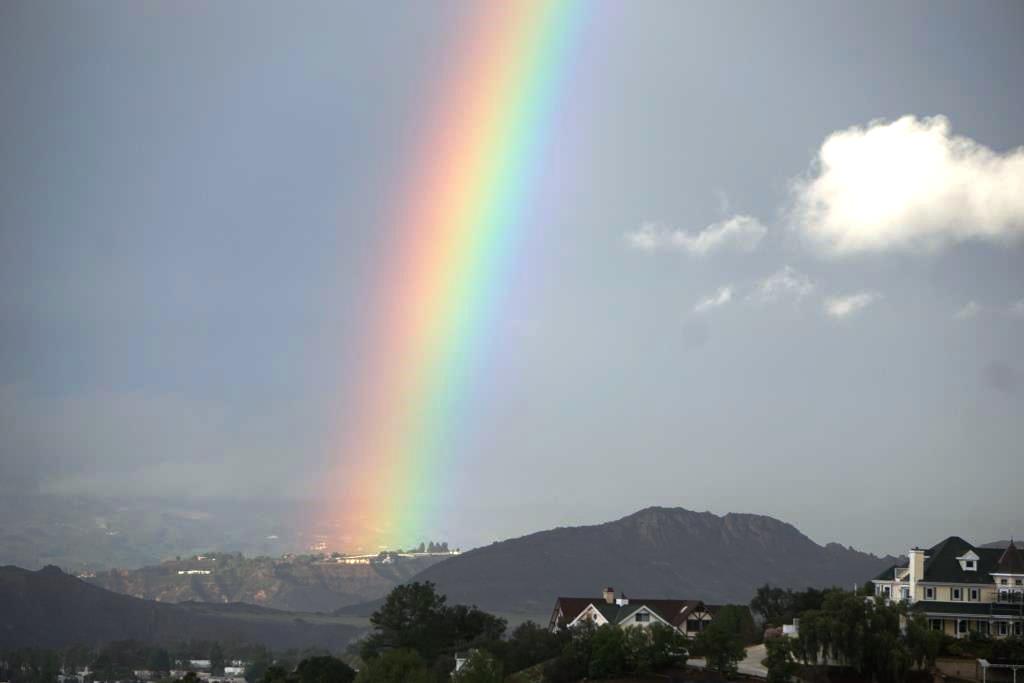
2016 Ends With a Beautiful Double Rainbow in the Conejo Valley and Surrounding Areas

As soon as I stepped outside just after 4pm today, I noticed the sun shining amid the clouds and I uttered out loud, "This is rainbow weather!" 

Sure enough, I was right. We drove a block and noticed the beautiful, massive rainbow in Thousand Oaks, but we missed the double rainbow that wowed local residents after an entire day of cloud cover, cold and rain.

Here are some of my favorites from THIS FACEBOOK POST.

Taken from Newbury Park

Taken from Newbury Park

My Favorite Tree in the Conejo Valley Resides in Rancho Sierra Vista, Newbury Park

Taken on Saturday, April 16, 2016

Taken on Saturday, April 16, 2016

Rumor has it there are, at least, 1,000 oak trees, in the Conejo Valley. My favorite tree in the Conejo Valley is this lone oak at Rancho Sierra Vista/Satwiwa in Newbury Park.

This oak tree stands there, in a field, all alone, in the shadow of Boney Mountain in the foreground, year in, year out, come rain, or more usually, come shine.

In times of drought, in times of natural disaster, like the Springs Fire of 2013, this lone oak has withstood the test of time.

Through good times and bad, this tree is there for me, and for all of us, standing tall in the face of the hot summer sun and soaking in the winter rains.

I've never touched this lone oak nor have I ventured beneath its branches. But I have admired it, mostly from afar. And I know this tree appreciates me. Sitting still, smiling in the summer sun, feeling comfort in the vast open space of the Conejo.

After a brief rainstorm in November 2016

After a brief rainstorm in November 2016

Supermoon as Viewed this Morning from the Conejo Valley

L. David Irete submitted this shot of the "supermoon" staring down the western Conejo Valley open space and Edison power lines in Newbury Park this morning. Last night's (and this morning's) supermoon was the closest full moon to the Earth since January 26, 1948.

Mark your calendars for November 25, 2034. That's when astronomers indicate the next time we will have a supermoon this close to earth.

Supermoon11.15.16.JPG

Aerial Photographs of Conejo Grade in 1957

7142 Conejo Grade 3-21-1957.jpg

The four mile stretch of Highway 101 that connects the Conejo Valley with Pleasant Valley is the Conejo Grade.  Originally constructed in 1915 with no less than 49 twists and turns, the Conejo Grade has been straightened and widened over the years to accommodate growing population needs.

The shot above was taken in 1957 by aerial photographer Walt Dibblee. You can clearly see remnants of prior iterations of the Conejo Grade from above. You also may notice the lack of, well, much of anything, at the top of the grade in Newbury Park.

Below is another shot, a bit closer up. As you can see, the Grade was not quite as wide in those days.

7301 Conejo Grade 1957 venturaviews.jpg

Thanks to Walt's son Steve Dibblee of VenturaViews.com

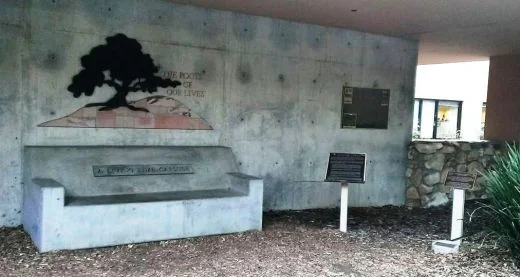
"The Roots of our Lives" Living Time Capsule at Thousand Oaks Civic Arts Plaza

The Roots of our Lives "Living Time Capsule" located at the Thousand Oaks Civic Arts Plaza

The Roots of our Lives "Living Time Capsule" located at the Thousand Oaks Civic Arts Plaza

The City of Thousand Oaks was incorporated in 1964 after a majority vote on September 29, 1964. Thirty years later, City leaders decided to do something very special by creating a "Living Time Capsule" designed to grow over the years.

CivicArtsPlazaCarpenter.jpg

In the front of the Thousand Oaks Civic Arts Plaza, on the east side behind the large Mary and Richard Carpenter Plaza Park sign, is "The Roots of our Lives," an area that contains the living time capsule.  A geocache led us here. Learn more about geocaching at this link.

TimeCapsuleTO_1.jpg

Here is the inscription on a sign next to the "Living Time Capsule" bench:

"A time capsule is encased within the bench below the specially designed oak tree and mountainscape relief with the time capsule theme, "The Roots of our Lives." It is filled with documents and artifacts reflective of the City of Thousand Oaks' rich historical heritage, and current public and private activities.

It is called "A Living Time Capsule" for it was designed to grow as our City grows, with each succeeding generation contributing to the contents of four time capsule containers. This is accomplished through a unique program, whereby:

  • A group of fifty ten year-old children were designated "Guardians of the Time Capsule" at the dedication on October 9, 1994. They will be back for the next opening of the time capsule when a new generation of "Guardians" will be chosen. This process will continue for the next three openings of the time capsule.

  • At its dedication on October 9, 1994, two of the four time capsule containers were filled and sealed.

  • The third container will be filled and sealed at the time capsule's opening on the City's 50th Anniversary, in the year 2014. This process will be repeated with the fourth container, on the City's 75th Anniversary, in the year 2039.

  • A final opening of all four containers will take place on the City's 100th Anniversary, in the year 2064."

TimeCapsuleTO_3.jpg
TimeCapsuleTO_4.jpg

Time Capsule created by the Greater Conejo Valley Chamber of Commerce was buried on November 20, 1989 and will be opened on November 20, 2039. Makes one ponder....will I be around to witness this?