The Chumash House at Rancho Sierra Vista/Satwiwa and Other Conejo Valley Locations

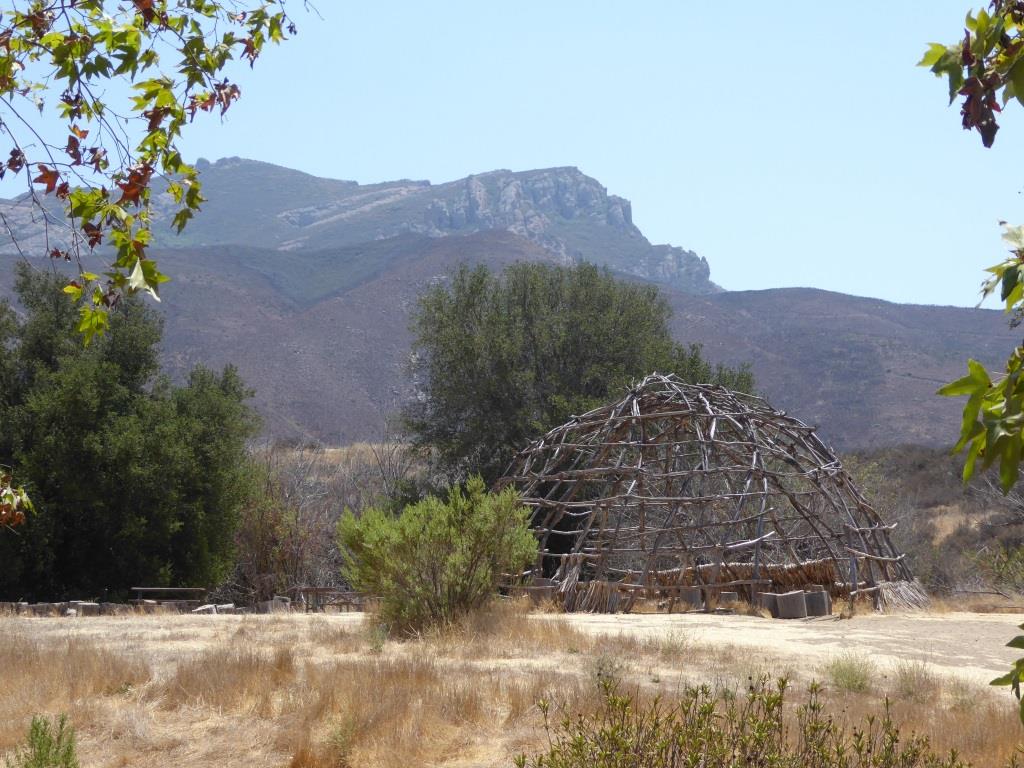
The Chumash home, or 'Ap, at Rancho Sierra Vista/Satwiwa in June 2017 (it was subsequently taken down and rebuilt (see video below).

The Chumash home, or 'Ap, at Rancho Sierra Vista/Satwiwa in June 2017 (it was subsequently taken down and rebuilt (see video below). unfortunately the newly built one also came down since then.

In front of the Satwiwa Native American Indian Culture Center in Rancho Sierra Vista/Satwiwa in Newbury Park is a replica Chumash home called an 'ap. An 'ap is shaped like half an orange and is made by setting willow poles in the ground in a circle, bending them into shape at the top to form a dome.

What is obviously missing from the 'ap above is the outer, vertical layers, cattails laid out like shingles. The 'aps in the Chumash Indian Village at the Chumash Indian Museum in Thousand Oaks display what those look like, as does the video below from June 2020 showing the rebuilt Satwiwa ‘ap.

'Aps at Chumash Indian Museum's demonstration village. These were destroyed by the Woolsey Fire of 2018 but will be rebuilt.

'Aps at Chumash Indian Museum's demonstration village. These were destroyed by the Woolsey Fire of 2018 but will be rebuilt.

Oakbrook Regional Park in March 2023 with two rebuilt ‘aps.

There is a hole at the top of the 'ap to allow for air circulation that was covered with an animal skin when it was raining.

The 'ap at Rancho Sierra Vista/Satwiwa in June 2017. I spoke with the ranger about this 'ap, which is quite past its prime and has become misshapen. At some point what the Chumash do, when an 'ap is no longer of use and needs to be re-built, is take…

The 'ap at Rancho Sierra Vista/Satwiwa in June 2017. I spoke with the ranger about this 'ap, which is quite past its prime and has become misshapen. At some point what the Chumash do, when an 'ap is no longer of use and needs to be re-built, is take the willow poles down and burn them in a ceremony.

Funny that many folks, my kids included, wonder why the Chumash did not live in teepees (or tipis). Teepees are cone-shaped tents made of animal skins on wooden poles that were used primarily by Native Americans in the Great Plains section of the U.S. (Kansas, Nebraska, South Dakota, North Dakota and portions of other prairie states). The Chumash did not live in teepees. 

There is also a Chumash 'ap on display as part of a Chumash Village exhibit at the Stagecoach Inn Museum in Newbury Park.

There is also a Chumash 'ap on display as part of a Chumash Village exhibit at the Stagecoach Inn Museum in Newbury Park.

The teepee structure at Wildwood Park in Thousand Oaks is fun to hike to and sit under but is not something the Chumash Indians would ever have lived in.

The teepee structure at Wildwood Park in Thousand Oaks is fun to hike to and sit under but is not something the Chumash Indians would ever have lived in.

An informational sign describing an ‘ap anis (village) at Oakbrook Regional Park in March 2023.

IRS Extends 2022 Tax Return Filing Deadline to October 16, 2023 in Most California Counties

Last week, the IRS extended the 2022 tax filing deadline for taxpayers in most California counties (including our local LA/Ventura/Santa Barbara/Orange counties) to October 16, 2023. The deadline was previously extended from April 18th to May 15th due to the January storms.

In addition to individual and business tax returns, this extension applies to funding IRAs and to making estimated tax payments for Q422 to Q323 (if applicable).

The state of California has conformed to extension of filings and payments to October 16th. See www.ftb.ca.gov/about-ftb/newsroom/news-releases/2023-03-ftb-california-winter-storm-tax-relief-extension.html for details.

The Beach Boys 1991 "Crocodile Rock" Music Video Filmed at Golf N' Stuff Ventura

"Crocodile Rock" was written by Elton John and Bernie Taupin and become Elton John's first U.S. number one single in February 1973. Eighteen years later, the Beach Boys recorded the song. Funny thing is that our own Golf N' Stuff in Ventura is featured in this kind of silly music video released in 1991.

Roughly half the video features familiar scenes from Golf N' Stuff, including several of the more prominent holes and structures as well as the bumper boats. Yes, the Beach Boys are featured on the bumper boats in their fedoras at Golf N' Stuff, along an offbeat display of scenes featuring a crocodile on the piano admired by a woman in a pink bikini, brief glimpses of Randy's Donuts and a cameo appearance by John Stamos.

Golf N' Stuff is often part of our family outings in Ventura County. Sign up for their email club and receive periodic special offers. Golf N' Stuff is among over 100 venues on this compilation of birthday party options in and around Ventura County.

The Corriganville Movie Ranch Site in Simi Valley is a Ventura County Historical Landmark

The Corriganville Movie Ranch Site in Simi Valley was designated a historical point of interest by the Ventura County Cultural Heritage Board in January 1982, then subsequently was redesignated as a historical landmark in August 1995.

Corriganville was a 1,500 acre piece of land in Simi Valley purchased by western film star Ray “Crash” Corrigan in 1937. The site was a working movie ranch for nearly three decades, and was used in the making of roughly 3,500 western films and television series such as Fort Apache, The Lone Ranger, and The Adventures of Rin Tin Tin. Actors like John Wayne, Gene Autry, Johnny Weissmuller, Tex Ritter, Joel McCrea, Dale Evans and so many others filmed movies here.

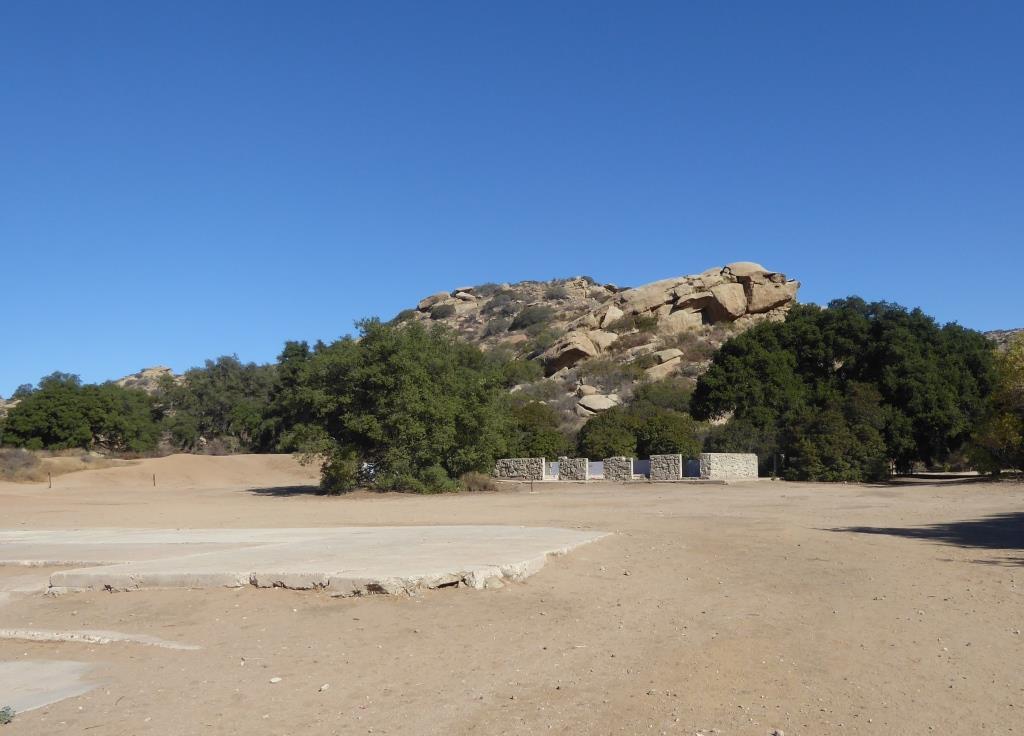
Corriganville today...the ranch burned down in the 1970s, leaving just these cement slabs and exterior walls.

Corriganville today...the ranch burned down in the 1970s, leaving just these cement slabs and exterior walls.

In 1949, the ranch opened to the public as “Corriganville,” a western themed amusement park. The ranch was later purchased by Bob Hope in 1965, deeming the ranch its alternative name, Hopetown. The ranch burned down in the 1970s and all that is left are the cement slabs and exterior rock walls of the barn. 

View of Corriganville Park from a trail on the east side of the park. The trail takes you up to 118 Freeway and a wildlife corridor tunnel that takes you under the freeway into Rocky Peak Park.

View of Corriganville Park from a trail on the east side of the park. The trail takes you up to 118 Freeway and a wildlife corridor tunnel that takes you under the freeway into Rocky Peak Park.

In 1988, 190 acres of the original ranch was purchased by the City of Simi Valley and is now owned and managed by the Rancho Simi Recreation and Park District. Corriganville Park is located at 1601 Kuehner Drive, Simi Valley and is open to the public for hiking, walking and exploring. For a detailed compilation of historical aspects of the site, visit www.corriganville.net.

A photo of the Corriganville Movie Ranch when it was an active movie set. Learn more about Corriganville and see a model of what it looked like in the 1960s at the nearby Santa Susana Depot Museum.

A photo of the Corriganville Movie Ranch when it was an active movie set. Learn more about Corriganville and see a model of what it looked like in the 1960s at the nearby Santa Susana Depot Museum.

Rotary Club of Simi Sunrise "Simi Smiles" Peace Project Rock Exchange at Corriganville Park

Rotary Club of Simi Sunrise recently installed a community peace themed rock exchange at Corriganville Park, 7001 Smith Road, Simi Valley.

Through the efforts of Simi Sunrise, the city of Simi Valley has been established as an International City of Peace, one of 375 Cities of Peace in 70 countries.

To encourage the community to promote peace, students were invited to design hand-painted rocks to spread peace, love and friendship. Over 500 rocks with these themes were created and were placed in a large peace sign formation adjacent to the Corriganville Park parking lot.

Learn more about the Rotary Club of Simi Sunrise at rotaryclubofsimisunrise.org.

More on the International Cities of Peace movement at www.internationalcitiesofpeace.org. Other local Cities of Peace include Ojai, Santa Barbara and Los Angeles.

Banning Dam (Lake Eleanor Dam) in Thousand Oaks is a Ventura County Historical Landmark

Banning Dam (also referred to as Lake Eleanor Dam) was designated as Ventura County Historical Landmark No. 120 in May 1988. Built in 1889 at 37 feet high and 140 feet long at its crest, the dam is located in a gorge adjacent to Westlake Boulevard, just south of Potrero Road. It is considered either the first or second concrete arched dam built in California.

The 8 acre Lake Eleanor can be seen as you are driving on Westlake Boulevard/Decker Canyon or you can do the Lake Eleanor Open Space Hike in Westlake Village for a view of the lake from above.

The lake and surrounding 529 acres of open space is fenced off from the public to create a habitat for wildlife. The area include rugged hills, rocky outcrops, freshwater marsh habitat, oak woodland and coastal sage scrub. Hawks and other large birds often use the outcrops for nesting sites and the area supports several species of rare/endangered plants.

The Lake Eleanor open space was acquired by the Conejo Open Space Conservation Agency in 1986. Banning Dam was designated City of Thousand Oaks historical point of interest No. 9 in May 1988.

Banning Dam

Banning Dam

All About the New Energy Efficient Home Improvement Credit for Tax Years Beginning in 2023

NOTE: New legislation signed in July 2025 eliminates the Energy Efficient Home Improvement Credit beginning in 2026.

Prior to 2022, the federal “Nonbusiness Energy Credit” allowed for a lifetime tax credit of a maximum of $500 for installation of certain energy-efficient exterior doors, windows, skylights, certain roofs and insulation. It also could be used for the purchase of certain central air conditioners, electric heat pumps, gas water heaters and certain other appliances.

The property must be installed in your personal residence and the credit was based on 10% of the cost of the purchases. There were additional credit limits of $200 for exterior windows and skylights, $300 for heat pumps, central AC and water heaters, $150 for furnaces and boilers and $50 for qualified main air-circulating fans. This credit was extended through 2022 and is claimed on Form 5695, filed with your federal tax return.

The Inflation Reduction Act of 2022 brought dramatic changes to this tax credit and renamed it the Energy Efficient Home Improvement Credit (let’s call it EEHIC). Instead of a $500 lifetime cap, there’s a $1200 ANNUAL cap, and the credit is based on 30% of the purchase price, increased from 10%. Additionally, there is a separate $2,000 per year cap allowed for qualified heat pumps and heat pump water heaters, biomass stoves and boilers.

EEHIC covers two main categories of purchases - Energy Efficient Home Improvements and Residential Energy Property.

Energy Efficient Home Improvements include insulation materials, exterior windows, including skylights, and exterior doors that meet certain Energy Star requirements.

Residential Energy Property covered by EEHIC must meet or exceed certain high-efficiency standards and includes the following:

  • Electric or natural gas heat pumps and heat pump water heaters

  • Central air conditioners

  • Natural gas, propane or oil water heaters, furnaces and hot water heaters

  • Biomass stoves or boilers, oil furnaces and hot water boilers

  • Improvements to or replacements of panelboards, sub-panelboards, branch circuits or feeders with a load capacity of 200 amps or more

What efficiency standards must be met? Here are some examples:

  • Natural gas water heaters: ENERGY STAR certified models > 0.81 UEF (Uniform Energy Factor) for tanks less than 55 gallons and > 0.86 UEF for tanks greater than or equal to 55 gallons.

  • Tankless gas water heaters: ENERGY STAR models with > 0.95 UEF are eligible. 

  • Exterior windows and skylights: Must meet ENERGY STAR “Most Efficient” criteria. See www.energystar.gov/products/most_efficient

Home Energy Audits are another new category included in the EEHIC. This is an inspection and written report by a certified auditor that identifies energy efficiency improvements, including an estimate of energy and cost savings.

In addition to the annual $1200 and $2000 tax credit caps mentioned above, there are additional annual caps as follows:

  • $250 cap on each exterior door, up to a total of $500 per year

  • $600 annual cap on exterior windows and skylights

  • $150 annual cap on home energy audits

  • $600 annual cap on each Residential Energy Property item

How is the cost determined? Does it include installation? The cost of Energy Efficient Home Improvements (e.g. insulation, windows, doors) DO NOT include labor. Residential Energy Property (e.g. water heaters, central air, heat pumps), DO include the cost of labor. See IRS FAQs at THIS LINK posted 12/22/22 for more details.

How long is EEHIC in place? From 2023 through 2032 (at the current time).

Does EEHIC apply only to my primary residence? Yes for Energy Efficient Home Improvements (again - insulation, windows and doors). For Residential Energy Property, it can be in any U.S. home owned by the taxpayer.

Is the EEHIC carried to future years if I can’t use it? No. If your taxes are lower than the credit, lucky you! But no, any unused credit is not carried forward to future year tax returns.

How do you claim the EEHIC? Form 5695, filed with your federal tax return. Starting in the 2024 tax return, taxpayers will need to provide the qualified product identification number for any items purchased

Confused? Yes, so am I. But with this summary, your own research, dealers/retailers and your CPA, you’ll get this nailed down and take advantage of these new tax credits.

For a nine page IRS Fact Sheet about the Energy Efficient Home Improvement Credit as well as the Residential Clean Energy Property Credit (e.g. solar credit, which is back to 30% from 2022 through 2032, then 26% in 2033 and 22% in 2034), visit www.irs.gov/pub/taxpros/fs-2022-40.pdf.

Learn more about Energy Star qualified products at www.energystar.gov/about/federal_tax_credits/non_business_energy_property_tax_credits.

One example of how to maximize the credit. Let’s say you’d like to replace 20 exterior windows on your home. The windows cost $400 apiece, excluding labor. If you install them all in one year, the cost would be $8,000 plus installation. $8,000 times 30% equals $2400, but your EEHIC is limited to $600, for a net cost of $7,400 plus installation. If you want to maximize the credit, you could buy 5 windows a year for 4 years at a cost of $2,000 per year, plus installation (ignoring inflation). By stretching the purchase over 4 years, you increase the tax credit from $600 to $2,400, for a net cost of $5,400 plus installation. Something to think about.

My Practical Experience

So I went to Home Depot to look for windows and water heaters that are qualified for EEHIC. I found a couple water heaters that met the requirements but the windows I had no clue which one did. So I thought, maybe I could figure it out by going back to the IRS Q&As at THIS LINK, which had a link to the ENERGY STAR website. So I entered my local zip code, which took me to a list of tax credits by product type at THIS PAGE. So I clicked Windows & Skylights Tax Credit at THIS PAGE. Then I clicked “Find Eligible Products” at THIS PAGE. Under Building Products I found the Windows, Door & Skylights category, which had a link to a “NFRC Directory” at THIS PAGE, where there are links to searches by region for the National Fenestration Rating Council. There’s no definition of what is in each region. So I guessed the Southern region, which I searched by product type, like Single and Double Hung Windows. From there, I saw a list of “Energy Star Partner” names. I picked Milgard, which then gave me a list of Milgard product lines that I’m going to assume meet the ENERGY STAR “most efficient” requirement (though it doesn’t clearly state that anywhere). So where do I buy these theoretically qualifying products? The site didn’t tell me. Bottom line: You’re probably going to have to just ask the retailer which products meet the IRS requirements as the IRS has not made this process easy.