Trail Etiquette Tips in the Conejo Valley and Surrounding Areas

The trails that surround us here in the Conejo Valley, including the Santa Monica Mountains maintained by the National Park Service, California State Parks and other organizations, as well as the Conejo Open Space, are a year-round wonderland for hikers, bikers, runners and equestrians. As such, it’s good to be reminded of the rules for trail etiquette.

Here is a summary of tips summarized in a brochure posted at trailetiquette.org:

Hikers, runners and mountain bikers must always yield to equestrians. Do so by immediately stopping and waiting on the downhill side of the trail. Greet the rider, as your voice also signals to the horse that you’re human and not a potential threat. Communicate with the rider and ask how to proceed. As beautiful as the horses are, do not approach or pet them without asking for permission first. If you are a cyclist, after communicating with the horse rider, pass slowly and steadily, without sudden movements or noises.

Hikers should always listen for cyclists, runners and equestrians approaching from behind. Listen for “on your left” so that you can stay to the right and let them by. Hike single-file on narrow trails and try to stay to the right on wider trails. Keep your dogs on short (6 feet maximum) leashes and of course, clean up after them. If you wear headphones, consider wearing only one earpiece or turning the volume down so you can hear your surroundings.

Bikers should slow down and yield to hikers and horses. Consider using a bell to alert others you are behind them. On a single track trail, downhill cyclists should yield to uphill cyclists.

And some other reminders…stay on the trails, don’t litter, don’t block the trail if you need to stop and don’t use the trails when the are wet and muddy.

And of course, be nice, smile at and greet your fellow trail users! We love our local trails!

GREAT TRAILS AND HIKES IN AND AROUND VENTURA COUNTY

How to Sign Up For Southern California Edison Outage Alerts

In extreme weather conditions, when heat and low humidity combine with high winds, Southern California Edison (SCE) may activate a Public Safety Power Shutoff (PSPS) when power is turned off in a high fire risk area.

Here in the Ventura County and Greater Los Angeles County area, one particularly challenging extreme weather condition arises when Santa Ana winds and low humidity increase the possibility of wildfire conditions.

Customers can report or inquire about outages at 800-611-1911 and get the latest information using the SCE outages app at sce.com/outages.

Find out which areas are under PSPS consideration or that have been de-energized at sce.com/psps

Customers can also get the latest information by visiting sce.com/staysafe or at twitter.com/sce and facebook.com/sce.

Customers can also receive outage alerts via email, voice message and/or text message. First, you have to register your account at sce.com.

After creating your account (which requires that you verify your account using an existing phone number on file, log in and update your contact information.

Then, go to My Account/Profile/Outage Alert Preferences and scroll down to the “Want to be notified?” section and click “Manage Notifications.” It takes seconds to complete and, wallah, you’ll receive outage updates in the future.

IRS Announces 2021 Tax Filing Season Will Begin on Friday, February 12th

Today, January 15th, the Internal Revenue Service announced that the 2021 tax season will start on Friday, February 12th. This is the date that the IRS will begin accepting and processing 2020 tax returns.

Why such a late start date this year? The IRS needs extra time to program and test its systems for the tax law changes signed into law on December 27th that provided a second round of Economic Impact Payments and other benefits.

You can still begin filing your returns through IRS Free File partners starting today. However, the returns will not be transmitted to the IRS until February 12th. Learn more about Free File at www.irs.gov/filing/free-file-do-your-federal-taxes-for-free.

The tax deadline for 2020 returns is April 15, 2021. Of course, you can always file an extension to file your returns by October 15th. However, you still must pay your anticipated 2020 taxes by April 15th.

Although tax seasons frequently begin in late January, there have been five instances since 2007 when filing seasons did not start for some taxpayers until February due to tax law changes made just before the start of tax time.

How to Obtain an IRS Transcript

If the above does not work and you primarily need information from the return but not necessarily a complete copy of the return, you can request a tax return transcript from the IRS. This can be done online (and almost immediately), by phone or by mail.

Obtaining an IRS Transcript Online

It’s actually quite simple obtaining a copy of tax return transcript or wage and income transcript at www.irs.gov/individuals/get-transcript. But first things first. You need to establish an eServices account with the IRS unless you already have one.

Setting up an eServices account at https://sa.www4.irs.gov/eauth/pub/es_general.jsp will take maybe 5 to 10 minutes. You’ll need the following information: Full name, Social Security Number, email, birthdate, most recent year’s tax filing status and current address. To verify your identity, the IRS will also need information from one of your financial accounts - such as the last eight digits of a credit card or other loan. You’ll also need your cell phone registered under your name to confirm you are you.

After you’ve set up your eServices account, you can log in to obtain your transcripts. Make sure your cell phone is handy, as the IRS uses two-factor authentication each time you log in. They will text a code to your phone.

When you log in, after selecting the reason for needing the transcript (e.g. Higher Education/Student Aid, FEMA/Disaster Related, etc.), you will have access to up to four years of return transcripts, five years of account transcripts and 10 years of wage and income transcripts.

transcripts.jpg

Obtaining an IRS Transcript by Phone or Mail

You can also call 800-908-9946 or complete and mail in Form 4506-T to obtain a transcript. There is no cost for this. The form is at www.irs.gov/forms-pubs/about-form-4506-t.

Request a Copy of Tax Return From the IRS

If the transcript is not sufficient and you otherwise are not able to obtain a copy of your tax return, you can request a copy using Form 4506. Copies of individual tax returns (1040, 1040-SR, etc.) can take up to 75 days to be processed, so get ready to wait.

43 fee.jpg

And yes, it does cost you to obtain a copy of the return. Up until very recently though, it was $50, But the new Form 4506 shows a fee of $43 for each return requested.

Returns are generally available for 7 years from filing before they are destroyed by law.

California Minimum Wages Increased Today, January 1, 2021 by $1 Per Hour

If you are a minimum wage earner in California, today you received a pay increase of 8.3% (from $12 to $13 per hour) if you work at an employer with under 26 employees or 7.7% ($13 to $14 per hour) if your employer has 26 or more employees.

Current law calls for one additional increase for larger companies on January 1, 2022 and two additional increases for smaller companies on January 1, 2022 and 2023 to get to $15. See chart below.

Min wage 1.1.21.jpg

The federal minimum wage for 2021 is $7.25, a rate that has stood frozen in time since it became effective on July 24, 2009.

California minimum wage rates apply to Ventura County residents.

City of Los Angeles and County of Los Angeles minimum wage rates are currently higher than Ventura County/California wage rates. They are:

  • $14.25 for employers with 25 or less employees until 7/1/21, when the rate increases to $15 per hour.

  • $15 for employers with 26 or more employees.

Looking for a higher minimum wage? Move to San Francisco, where the rate is currently a nice, even $16.07 per hour. The rate is adjusted for inflation on July 1st of each year. If you’re going to have a minimum wage rate in the first place, this actually sounds like a reasonable way to administer it.

Coronavirus (COVID-19) Case Tallies and Deaths in Ventura County, California and the World (2020)

Local area COVID-19 updates and news items are at THIS LINK. This page will be updated periodically with information on Ventura County area cases from VCEmergency.com (and www.venturacountyrecovers.org), U.S. cases from the CDC and global cases from the World Health Organization.

2021 coronavirus stats at THIS LINK.

Note that previously reported case counts are subject to changes and updates. We report initial case counts reported on these sites that in particular in the global stats change over time. For more accurate up to date counts at the global level, visit the WHO website at who.sprinklr.com.

Find Ventura County COVID-19 testing locations at www.venturacountyrecovers.org/coronavirus-testing.

September 2020

August 2020 Ventura County by Age
July 2020.
Month of June

Month of June

Month of May

Month of May

Through April 30th

Through April 30th

October 2020 - Ventura County by City/Community

September 2020

September 2020

July 2020 Ventura County by Location549 new cases reported 7/6 are from Thu to Sun. 292 have lab collection date of 6/29 or earlier.
Month of June - VC by location

Month of June - VC by location

Month of May

Month of May

March 20 to April 30, 2020

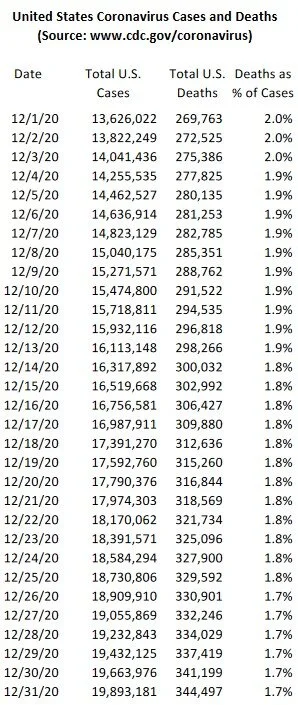
12.31.20 Corona US.jpg
11.30.20 Corona US.jpg
10.31.20 Corona US.jpg
Month of September 2020

Month of September 2020

Month of August 2020

Month of August 2020

Month of July - U.S.

Month of July - U.S.

Month of June - US

Month of June - US

Month of May

Month of May

Through April 30th

Through April 30th


September 2020 Top 12 Global Covid Cases

Month of August 2020 Top 12 Global Covid Cases

Month of July 2021 - Top 12 Countries

Month of June - Global Top 12 Countries

Month of May - Global Top 10 Countries

Note that the U.S. tally reported by the WHO today lags the U.S. reported tally by a day.

Beginning in Tax Year 2020, Eligible U.S. Taxpayers May Deduct up to $300 in Charitable Contributions from Gross Income

The CARES Act of 2020 brought about a change in how the IRS defines “Adjusted Gross Income” (AGI) on your tax returns.

Starting in 2020, “the amount (not to exceed $300) of qualified charitable contributions made by an eligible individual during the taxable year” are deducted, among other things, from gross income, in determining AGI.

The above language came out of the Internal Revenue Code. Let’s attempt to decipher this into language actual humans can understand.

The Short Answer

II you do not itemize deductions, starting in 2020, you can take as much as $300 in charitable contributions you make during the year. This reduces your taxable income and you may owe less taxes as a result.

How much less in taxes depend on your tax bracket, which can vary from 0 to 37% on your federal tax return. If you are already paying no federal taxes, this won’t change your tax bill. But otherwise, if you’re in, say, the 22% bracket and you gave $300 to charity, your tax bill will be lower by about $66.

What about state taxes? It’s not clear yet if California state law will conform to this law. If it does, that could save you a few more $$ on your state tax return.

Cash Contributions Only

Only charitable contributions made in cash (or credit card) are considered for this deduction. Non-cash deductions, such as giving used household items to Goodwill, are not included.

As a reminder, cash contributions to charities less than $250 require one of the following forms of documentation by the IRS: A bank record (e.g. canceled check or bank/credit card statement); a receipt showing the date, amount and name of the charity; or a payroll record, if it was withheld from your paycheck. Cash contributions over $250 also require a written acknowledgement from the charity showing date and amount and if any goods or services (other than religious benefits) were provided. You don’t need to attach this information to your return or anything; just keep it in your files.

$300 Per Return

So how does the $300 work for married couples? Is it $300 each? Nope. The $300 applies to all taxpayers. Yet another example of the “marriage penalty.” The $300 is per return.

What if you file married filing separate? There has been no clarification on this yet. We shall see.

Can I Take the Deduction If We Itemize Deductions?

No. If you itemize deductions, take the deduction there. If you are reading this, chances are that you did not itemize deductions in 2019. Before the Tax Cuts and Jobs Act of 2017 (TCJA), about 30% of taxpayers itemized deductions. After TCJA, it is estimated that only 10% of taxpayers itemize.

So give away if you can! Local Ventura County area charities at THIS LINK.