Banana Boat UltraMist Sunscreens Recalled Due to Risk of Product Igniting on Skin

Energizer Holdings, Inc., the makers of products like Schick razors, Playtex feminine products, Wet Ones wipes, Hawaiian Tropic suncare products and, of course, batteries, recently announced a voluntary nationwide market withdrawal nearly two dozen of its continuous spray Banana Boat sun care products. CLICK HERE for a list of the affected products.

The product is being removed because of a concern that the spray valve on the products dispenses too much of the product, resulting in its taking longer to dry on the skin than typical. As a result, if the user comes into contact with a flame or spark before the product is completely dry, the product has the potential to ignite.

Heck, it never even occurred to me that this could happen. Good thing I don't smoke! Energizer indicates that consumers should avoid sources of ignition and smoking when using these products.

Five people weren't so lucky. Energizer received reports of five people suffering burns related to the use of the Banana Boat SPORT Ultramist SPF 30 and 50 products.

Banana Boat has notified retailers to stop selling the product and anticipates it will be offering new continuous spray products soon. The products were distributed to retailers from January 2010 to September 2012.

Consumers are advised not to use the products. Any questions can be directed to Consumer Affairs at 800-SAFESUN (800-723-3786) Monday through Friday, 8am to 7pm Eastern time or by emailing them at SUNCARE@customerfollowup.info.

Sunscreens seem to be in the news a lot these days! Coppertone recently agreed to stop calling its sunscreens "waterproof" and "sweatproof."

California Law AB 1536 Allows Hands-Free Texting in Cars Beginning January 1, 2013

From the One More Reason to Stay Off the Roads Department. In July Governor Jerry Brown signed into law Assemblyman Jeff Miller of Corona's measure AB 1536 he refers to as the "Freedom to Communicate" bill.

AB 1536 states:

Existing law prohibits a person from driving a motor vehicle while using an electronic wireless communications device to write, send, or read a text-based communication, except as specified. This bill would remove that prohibition if the person is using an electronic wireless communications device that is specifically designed and configured to allow voice-operated and hands-free operation to dictate, send, or listen to a text-based communication, and it is used in that manner while driving.

Miller's press release proudly states: "Today marks a huge victory for commuters as AB 1536 will now make it easier to utilize new technology to its full advantage, allowing Californians to communicate safely and responsibly while on the road," and ..."I (Miller) am thrilled to announce that Californians will now be able to communicate with friends, family and business partners while driving because it is currently against the law to operate text based functions while driving."

OK, so how does this work? Well remember, you still can't hold your phone or press any buttons on the phone. It does have to be hands free.

AB 1536 states "write, send, or read a text-based communication" means using an electronic wireless communications device to manually communicate with any person using a text-based communication, including, but not limited to, communications referred to as a text message, instant message, or electronic mail. I suppose "not limited to" would include things like Tweets, Facebook posts, etc.

We've had our "no texting while driving" law in place since January 1, 2009. It was only a matter of time that an exception be made. Allowing hands-free text messaging no doubt is much more important than things like unemployment and education in our state, right?

Ford has a voice-activated system called "Sync" in its cars that, among other things, allows you to listen to incoming texts on your phone and "respond with a set of up to 15 preset outgoing messages such as 'Can't talk right now' or 'Where are you?'"

Yay!! Can't wait to get in the car to text my friends and family!! Yippee!!

November 6, 2012 Presidential General Election Registration and Key Voting Dates

The State of California has made it easier to register to vote by offering online voter registration for this coming November 6, 2012 Presidential General Election.

To register online, visit rtv.sos.ca.gov/elections/register-to-vote to start the online process or learn more at registertovote.ca.gov. The system will search the DMV database for your California driver license or ID card, date of birth and last four digits of your SSN. The Ventura County Clerk and Recorder Elections Division will contact you when the registration is approved or if additional information is needed.

You can also register to vote the old fashioned way by picking up a paper voter registration application at the Ventura County elections office, library, DMV or post office. More info at www.sos.ca.gov/elections/elections_vr.htm.

To vote for the November 6th election you must register by October 22, 2012!

Beginning October 8th, you may vote at the County of Ventura Elections Division, 800 S. Victoria Avenue, Ventura, from 8 a.m. to 5 p.m. Monday through Friday. Call 805.654.2664 or 800.500.3555 for additional information.

If you receive a Vote by Mail ballot, you may mail that in starting October 8th. However, keep in mind that Vote by Mail ballots must be received by the Elections Division office or any Ventura County polling place no later than 8 p.m. on Election Day. Completed Vote By Mail ballots may also be dropped off before Election Day at any of the 10 City Clerk’s offices countywide or in the 24-hour ballot drop off box located in front of the Hall of Administration at the Government Center in Ventura.

I love having the option of voting by mail. For many years I've been on "Permanent Vote by Mail" status and automatically receive my ballot so I can let it sit on my desk as I procrastinate until Election Day. If you want to receive a Vote by Mail ballot, either on a one-time or permanent basis, complete the form on the back page of the Sample Ballot you received in the mail. It must be received by 5 p.m. on October 30th (one day before HALLOWEEN!).

To find out if you are registered to vote, the Ventura County Clerk and Recorder Elections Division website has a handy tool where you type your name and date of birth. If you are registered, they tell you where your polling place is, not to mention the date you registered and what your party affiliation is (hmm, this seems overkill to me...if you know someone's name and birth date, you can find out their party affiliation).

I noticed when using the tool that you have to type the exact name you registered under. Nicknames or shortened names don't work. Visit recorder.countyofventura.org/elections/voter-lookups/am-i-a-registered-voter to check this feature out.

NOW GO ON, GET OUT THERE AND VOTE!

Drop, Cover and Hold On in the Great California ShakeOut on October 18, 2012

The Southern California (West) area is highly susceptible to earthquakes and earthquake related effects. Numerous earthquake faults crisscross southern California and no one within the area resides more than 10 miles from an active fault. In addition to damage caused directly by groundshaking and related groundfailure, other hazards such as fires can easily start during and shortly after an earthquake.

The driving force of earthquakes in California is movement along the San Andreas Fault and the many associated faults within the San Andreas Fault System that form the tectonic boundary between the Pacific and North American tectonic plates. Along this boundary, the Pacific Plate is moving slowly to the northwest relative to the North American Plate. The Pacific plate underlies most of the Pacific Ocean, as well as all California west of the San Andreas fault. When most people think of earthquakes in California, the San Andreas Fault is usually the first thing to pop in their minds, and while the San Andreas Fault is the longest fault in the state it is by no means the only one to be concerned with. Many other faults are found directly beneath our cities in some of the most densely populated areas.

Because you live in the Southern California (West) area, it is likely that a damaging earthquake will occur and affect you during your lifetime. You decide your fate. You decide your future. The steps you take now can mean the difference between your success or failure after the next big quake.

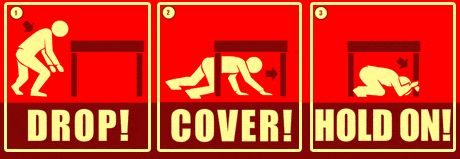
Start preparing on Thursday, October 18, 2012 at 10:18 a.m. by participating in the Great California ShakeOut drill! Joins millions of other Californians and over 100,000 Ventura County participants who will Drop, Cover and Hold On on that date.

Learn more about the Great ShakeOut at www.shakeout.org. Register for the California ShakeOut at www.shakeout.org/california/register/index.php.

 Now, about that Drop, Cover and Hold On drill (more at www.shakeout.org/california/dropcoverholdon)

  • DROP to the ground (before the earthquake drops you!)
  • Take COVER by getting under a sturdy desk or table, and
  • HOLD ON to it until the shaking stops.

Carmageddon II: 53 Hour I-405 Freeway Shutdown Planned for Sept 29-30, 2012

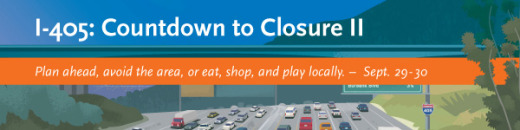
The second 10-mile closure of both directions of the I-405 over the Sepulveda Pass, popularly known as “Carmageddon,” has now been scheduled for Sept. 29- 30, 2012, when contractors will demolish the remaining side of the Mulholland Bridge.

The I-405 is the nation’s busiest freeway and will be closed in both directions for 53 consecutive hours between the I-10 and U.S. 101. Half a million motorists drive this portion of the I-405 over a typical weekend.

Motorists are advised to avoid the area to minimize auto congestion in the project area and throughout the greater Los Angeles region.

On Friday, September 28, ramps along the 10-mile closure area will begin to be shut down as early as 7 p.m., and closure of individual freeway lanes will begin at 10 p.m. to ensure full freeway closure by midnight. The closure is scheduled to continue until 5 a

Read More

Regional Art Museum is Renamed California Museum of Art Thousand Oaks

The California Museum of Art Thousand Oaks (CMATO) is the new name for the Regional Art Museum (RAM).  The new name was announced at a town hall meeting on September 18, 2012.  The new name fully encompasses the mission and vision of the museum that will serve the communities of California. 

The development of a world-class art museum as a cultural centerpiece for our community is coming to fruition. The museum will be a vital resource and will offer access to, education of, and appreciation for contemporary and traditional fine arts. The museum will be located adjacent to the Civic Arts Plaza.

The CMATO's mission is committed to serving diverse audiences through the exhibition, interpretation, and exploration of the fine and design arts.

To learn more about the planned CMATO and how you can support efforts to bring it to fruition, visit www.cmato.org.

The CDC Warns That Turtles and Other Reptiles are Risky Pets Due to Salmonella

Turtles and other reptiles are risky pets

Turtles are colorful and cute and are often kept as pets. However, many people don’t know that turtles and other reptiles like snakes and lizards can carry harmful germs that can make people very sick. For this reason, turtles and other reptiles might not be the best pets for your family, particularly if there are children 5 years old and younger or people with weakened immune systems in your home.

Turtles and other reptiles  often carry a germ called Salmonella, but appear perfectly healthy and clean. People think Salmonella infections are caused only by contaminated food, but these germs can also be caught by touching animals, including reptiles or amphibians, such as frogs. Salmonella infections can also result from having contact with an animal’s habitat, including the water from containers or tanks where they live.

Salmonella germs can make people sick with diarrhea, vomiting, fever, and sometimes abdominal cramps. This illness is called “salmonellosis.” Some people can become so sick that they need to go to the hospital. In severe illnesses, the Salmonella bacteria may spread to the bloodstream and can lead to death unless the person is treated promptly with antibiotics.

Young children are at increased risk for Salmonella illness because their immune systems are still developing. They also are more likely to put their fingers or other items that have come into contact with germs into their mouths. So, families with young children should avoid keeping turtles as pets, and turtles should not be allowed in schools or child care facilities with young children.

Since 1975, it has been illegal in the United States to sell or distribute small turtles with shells that measure less than 4 inches in length. This size was chosen because young children are more likely to treat smaller turtles as toys and put them in their mouths. This ban, enforced by the U.S. Food and Drug Administration, likely remains the most effective public health action to prevent Salmonella infections associated with turtles.

Since 2006, CDC has received reports of 11 multistate outbreaks, including 6 ongoing outbreaks, and more than 535 cases of laboratory-confirmed Salmonella infections linked to contact with small turtles and their habitats. These illnesses resulted in about 85 hospitalizations and one death. Because many people with salmonellosis do not seek medical care or are not tested, it is estimated that 16 times as many illnesses occurred than were reported.

Tips to reduce the risk of illness from turtles and other reptiles:

  1. Don’t buy small turtles from street vendors, websites, pet stores, or other sources.
  2. Wash your hands thoroughly with soap and warm water immediately after touching a reptile or anything in the area where they live and roam. Use hand sanitizer if soap and water are not readily available. Adults should always supervise hand washing for young children.
  3. Don’t let young children handle or touch reptiles or anything in the area where they live and roam, including water from containers or tanks.
  4. Keep reptiles out of homes with young children or people with weakened immune systems.
  5. Reptiles should not be kept in child care centers, nursery schools, or other facilities with young children.
  6. Don’t touch your mouth after handling reptiles and do not eat or drink around these animals.
  7. Don’t let reptiles roam freely throughout the house or in areas where food or drink is prepared, served, or stored, such as kitchens, pantries, or outdoor patios.

For more information on protecting yourself and your family from illness and to learn more about safely cleaning reptile habitats, please visit www.cdc.gov/Features/SalmonellaFrogTurtle.