Daylight Saving Time is Back Again on the 2nd Sunday of March

Daylight Saving** Time is coming back again! Yes, this will take place on Sunday, March 8, 2026. When the clock strikes 2 a.m. that morning, you will lose one hour of beauty sleep. Daylight Saving Time begins in most of the U.S. on the 2nd Sunday of March.

So try to get to bed early that night or you may feel grumpy on Monday! Especially when you realize it feels a lot darker that morning. But the good thing is, it'll be a lot lighter out at dinnertime!

** Contrary to what many of us think, it is called Daylight Saving Time, not Savings Time. Make sure to correct anyone who says it wrong if you really want to get on their nerves. But the reality of it is that we're not saving any daylight, we're just shifting it around.

Before the adoption of standard time zones in the United States, cities, towns, and communities set their own local times based on the sun’s position. In 1883, railroad companies adopted a system of standard time to synchronize movement and trade across the nation. The U.S. adopted an official system of standard time in 1918.

The Standard Time Act of 1918 incorporated a DST mandate from the last Sunday in March to the last Sunday in October. Congress repealed the DST mandate in 1919. President Woodrow Wilson vetoed the repeal. Congress overrode his veto.

Beginning in 1920, DST was a local state/city option. Here’s the history of DST legislation in California:

1930: Prop 7 was but on the ballot to implement DST at 2 a.m. on the last Sunday in April until 2 a.m. on the last Sunday in September. The initiative failed.

1940: Prop 5 was put on the ballot to implement DST. The initiative failed again.

1949: Third time’s a charm. This time it passed.

1962: Prop 6 was passed, which extended DST from the last Sunday in September to the last Sunday in October.

2018: Californians voted in favor of Proposition 7 by a margin of 59.75% to 40.25%. Voting in favor of the proposition allowed the California State Legislature to change the DST period by a 2/3rds vote and to establish permanent, year-round DST in California by a 2/3rds vote if federal law is changed to allow for permanent DST.

Why the holdup?

The holdup is at the federal level, not the state level: Voting yes on Prop 7 was just the first step in the process. California is one of 14 states that introduced legislation in 2019 to shift to permanent daylight saving time. States cannot move forward with permanent daylight saving time without authorization from the federal government. As of November 2019, there were 4 bills awaiting action in Congress that would allow California to be on permanent DST. These were:

H.R. 1556 “Sunshine Protection Act of 2019,” introduced to the House 3/6/19. The bill makes DST the new, permanent standard time. States with areas exempt from DST may choose the standard time for those areas. The bill was pending a hearing in the House Energy and Commerce Committee. S.670 is an identical bill in the Senate, pending a hearing in the Senate Commerce, Science and Transportation Committee. These have gone nowhere.

H.R. 1601 “Daylight Act” and H.R. 2389 “To allow states to elect to observe year-round DST” both authorize states to shift to permanent daylight saving time and are pending hearings in the House Energy and Commerce Committee. These have also gone nowhere.
The Story of Jungleland in Thousand Oaks

The Thousand Oaks Civic Arts Plaza is located on historic land in many respects. The land was originally part of "Rancho El Conejo," a Spanish land grant. Egbert Starr Newbury purchased 2,259 acres of this land in 1874 and built a home here (more on Newbury and his local legacy at THIS LINK).

After a drought in 1876-1877 bankrupted the Newbury family, the land was foreclosed and sold to the Crowley family in 1887, who built a successful ranch on the land. In 1910, Frank Crowley's parents built him a five bedroom, two story home on the land that is located at 2522 Pleasant Way. The Crowley family lived on the ranch until 1922.

The "Crowley House" went through several ownership changes through the years but is now maintained by the Conejo Recreation and Park District and is considered a Ventura County Historical Landmark.

One of the subsequent owners of the Crowley House was Louis and Kathleen Goebel. In 1925, Goebel purchased former Newbury/Crowley land where the Thousand Oaks Civic Arts Plaza currently stands.  It cost him $50. Louis Goebel soon opened Goebel's Lion Farm, where he trained lions and rented them to movie studios.

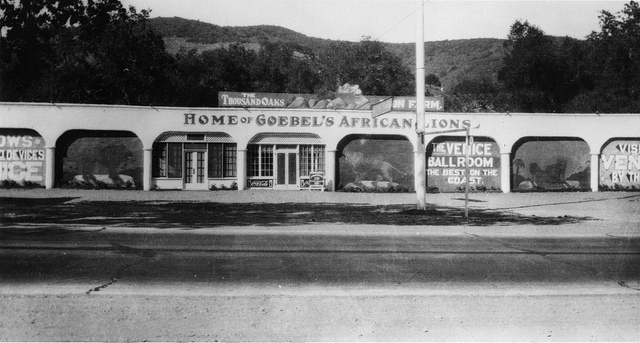
"Home of Goebel's African Lions" circa 1929 (Courtesy of Conejo Through the Lens, Thousand Oaks Library)

"Home of Goebel's African Lions" circa 1929 (Courtesy of Conejo Through the Lens, Thousand Oaks Library)

As travelers passed through town, they wanted to see the animals. Goebel capitalized on this in 1929, when the site became "Goebel's Wild Animal Farm," a theme park that became very popular in the 1940s and 1950s. The 170 acre site housed all sorts of animals...elephants, tigers, giraffes, hippos, chimpanzees and more. Additionally, many TV shows and movies were filmed there, such as Tarzan, The Adventures of Robin Hood and Birth of a Nation.

Goebel's Wild Animal Farm was home to Leo the Lion, of MGM Pictures fame. Over the years, other animal celebrity residents included Mr. Ed, the talking horse, Bimbo, the elephant from Circus Boy and Tamba, the chimpanzee in Tarzan films and "Bedtime with Bonzo" starring Ronald Reagan and Diana Lynn.

Goebel sold the business in 1946 and the park was renamed the "World Jungle Compound." Ten years later it was sold again to executives from 20th Century Fox and was renamed "Jungleland." After five years, the business slid and Goebel was able to purchase it back in 1961. 

In between Goebel's Lion Farm and Jungleland, from 1946 to 1955 the tourist destination was called the "World Jungle Compound" (Courtesy of CONEJO THROUGH THE LENS, THOUSAND OAKS LIBRARY.)

In between Goebel's Lion Farm and Jungleland, from 1946 to 1955 the tourist destination was called the "World Jungle Compound" (Courtesy of CONEJO THROUGH THE LENS, THOUSAND OAKS LIBRARY.)

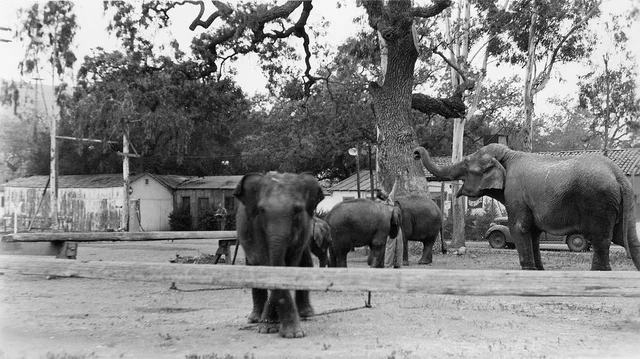
Five elephants at Goebel's Lion Farm (from the Ethel Nixon Collection (via Conejo Through the Lens, Thousand Oaks Library.)

Five elephants at Goebel's Lion Farm (from the Ethel Nixon Collection (via Conejo Through the Lens, Thousand Oaks Library.)

At its peak popularity, the 170 acre Jungleland compound had all sorts of activities - shows by tiger trainer Mabel Stark, and others, elephant rides, tortoise rides, ducky boat rides, train rides, safari tram buses and even a sky tram. Animals included elephants, lions, tigers, hippos, camels, llamas, giraffes, orangutans, chimpanzees and a variety of others.

Jungleland closed in October 1969 after its popularity continued to drop - a combination of increased competition (Disneyland, Knotts Berry Farm, Universal Studios, etc.) and the fact that Highway 101 diverted drivers around the theme park. The park operated for 43 years and its 1,800 animal occupants were sold at auction. 

So...when you stroll through the grounds of the Civic Arts Plaza and The Lakes at Thousand Oaks, close your eyes and see if you can envision all the animal excitement that took place here just a few generations ago in the heart of Thousand Oaks.

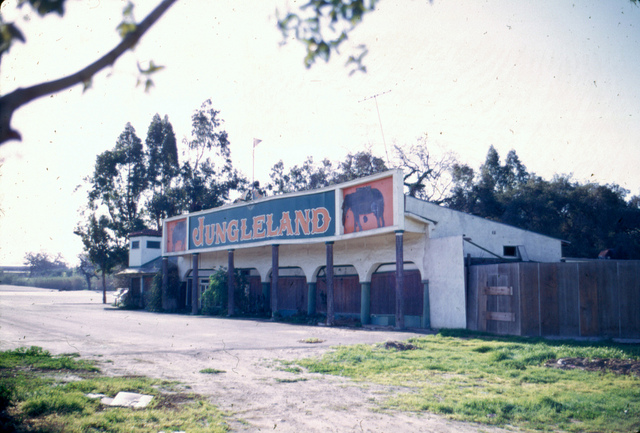
Jungleland sign after the theme park closed in 1969. (Image courtesy of Conejo Through the Lens, Thousand Oaks Library.)

Jungleland sign after the theme park closed in 1969. (Image courtesy of Conejo Through the Lens, Thousand Oaks Library.)

Louis Goebel and Jungleland plaque outside the Civic Arts Plaza.

Louis Goebel and Jungleland plaque outside the Civic Arts Plaza.

More on Jungleland on the Stagecoach Inn Museum website at stagecoachinnmuseum.com/jungleland.

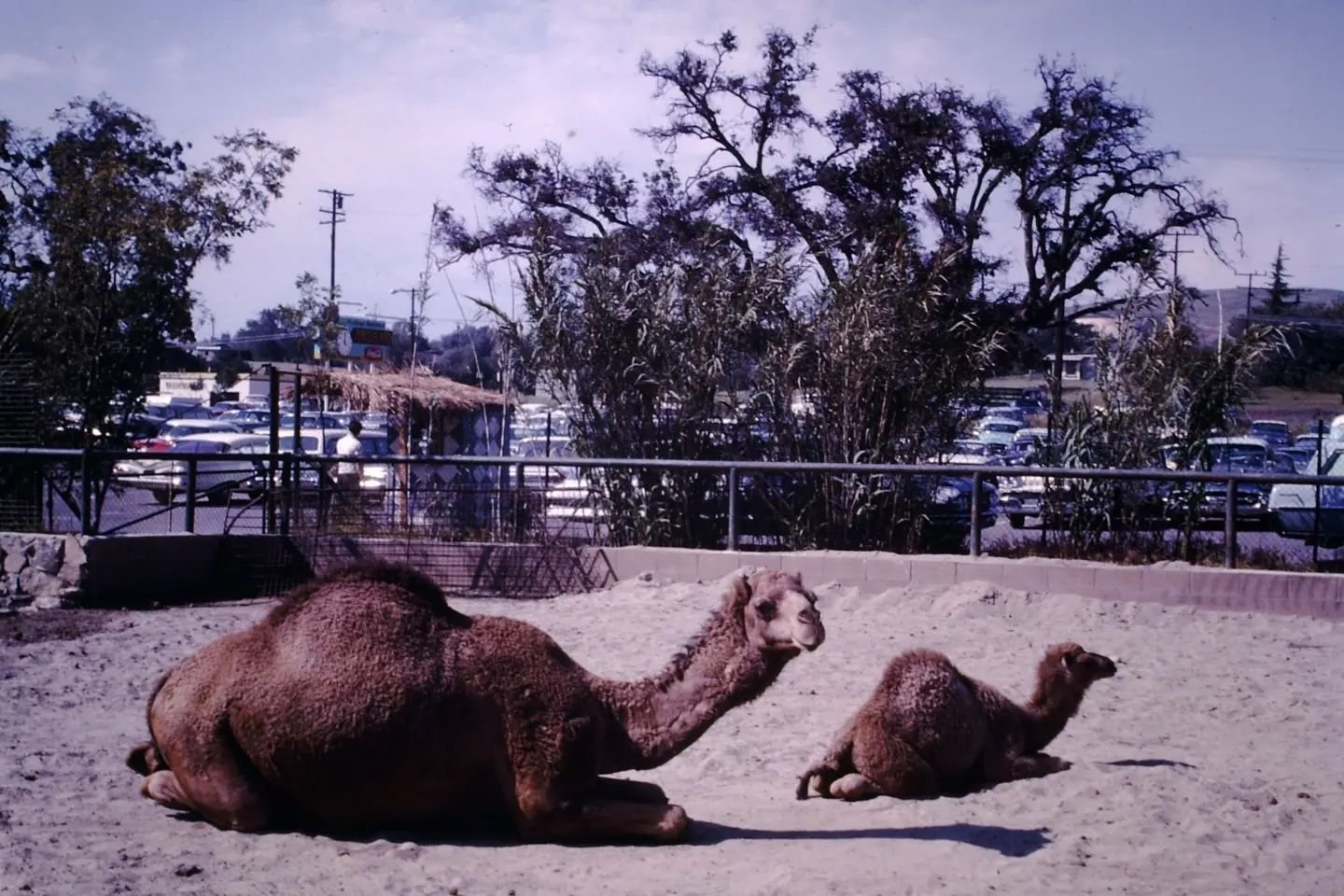
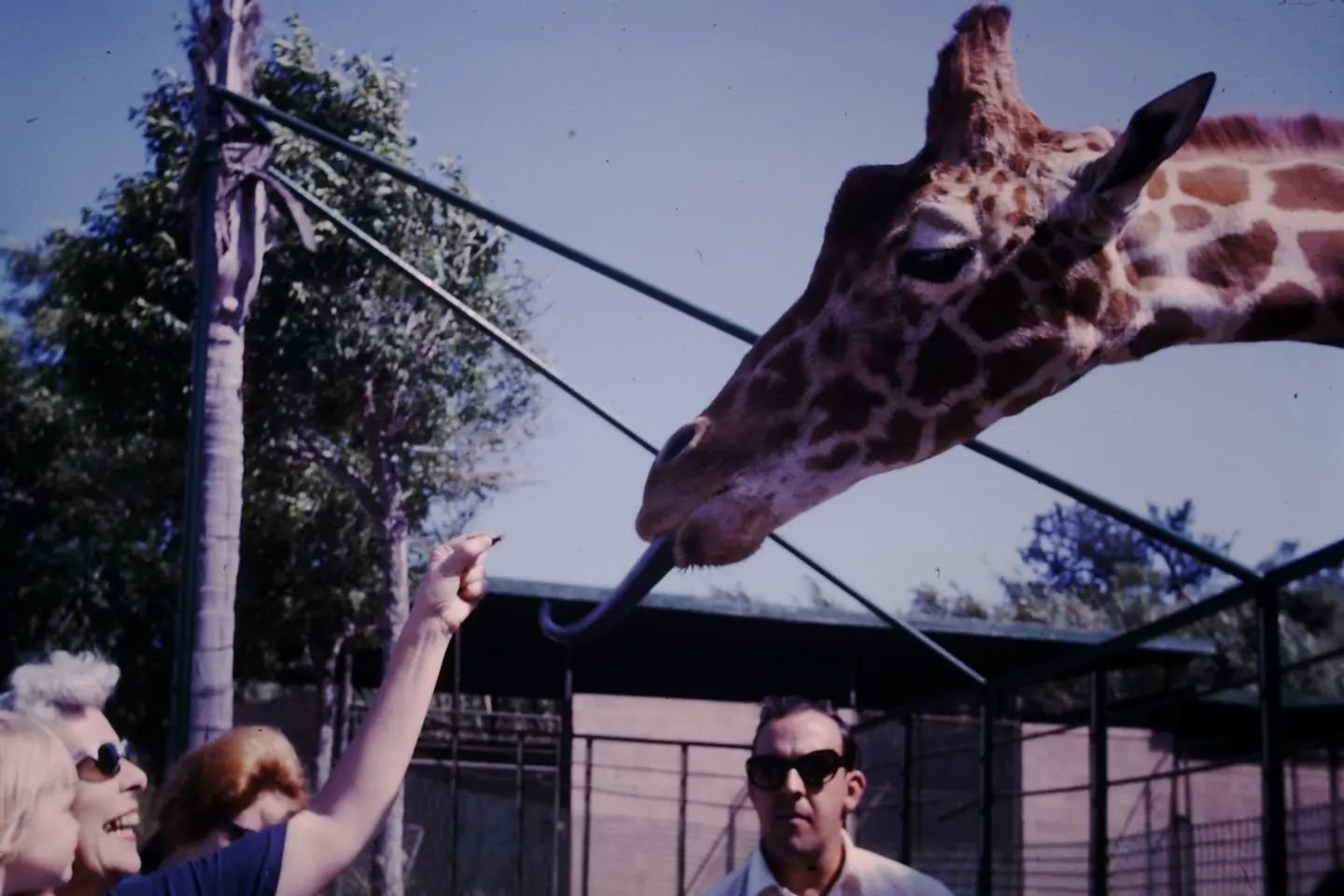
Some photos from around 1965 (from a private collection):

Volunteer Opportunities in Ventura County

iStock_Volunteer.jpg

Looking for a job? Why not help yourself by filling in the gaps in your resume with new experiences while helping others! Or if you are just looking to give back to the local community, there are hundreds of opportunities to volunteer throughout Ventura County. Here's where to find volunteer opportunities:

The United Way of Ventura County hosts www.VolunteerVenturaCounty.org, which lists numerous upcoming volunteer opportunities.

Since 1998, VolunteerMatch.org has helped volunteers find over 4 million volunteer matches at over 60,000 non-profits across the country.

Or visit the Local Charities section of Conejo Valley Guide and you'll find over 100 Ventura County area non-profit organizations, most of which could use your help. I clicked a few and found plenty of volunteer needs publicized on each entity's website, like MANNA Food Bank, L.I.F.E. Animal Rescue in Agoura, Hospice of the Conejo, Friends of the Thousand Oaks Library, and CareGivers - Volunteers Assisting the Elderly.

You could also join one of over 80 service organizations in the Service Clubs section of CVG. The Rotary, Kiwanis, Optimist, Assistance League, Lions Club and other organizations provide needed services to others in need. 

ActionVC is a non-profit that seeks volunteers to serve the vulnerable in our local community. www.actionvc.org/volunteer

Habitat for Humanity of Ventura County seeks volunteers at www.habitatventura.org/volunteer.

The Ventura County Resource Conservation District seeks volunteers to further its mission to conserve the natural resources of Ventura County at www.vcrcd.org/volunteer.

The Ventura County Medical Reserve Corps is a volunteer network that provides support for public health, emergency response, first aid services for local events and other local needs. www.venturacountymrc.org

Volunteer opportunities in Thousand Oaks: toaks.org/departments/human-resources/volunteer

Volunteer opportunities in Simi Valley: www.simivalley.org/index.aspx?page=355

Volunteer opportunities in Camarillo: www.cityofcamarillo.org/departments/city_manager/volunteers.php

Volunteer opportunities in Moorpark: moorparkca.gov/389/Volunteering-in-Moorpark

Volunteering in the City of Westlake Village: www.wlv.org/index.aspx?nid=320

Volunteering for the County of Ventura: hr.ventura.org/volunteer

How about the National Park Service? Check the local Santa Monica Mountains volunteer opportunities and Channel Islands National Park volunteer opportunities.

Also check out the volunteer opportunities with the Mountains Recreation and Conservation Authority. mrca.ca.gov/educational-outreach-programs/volunteer-2

And more links to volunteering opportunities:

Conejo Recreation and Park District www.crpd.org/support/volunteer

Pleasant Valley Recreation and Park District www.pvrpd.org/volunteer

Rancho Simi Recreation and Park District www.rsrpd.org/recreation/volunteers.php

Los Robles Hospital volunteer opportunities for adults and high school students www.losrobleshospitalvolunteers.com

Thousand Oaks Library www.tolibrary.org/services/get-involved/library-volunteers

Boys and Girls Clubs of Greater Conejo Valley www.bgcconejo.org/get-involved/volunteer

Food Share of Ventura County foodshare.com/volunteer

Retired and Senior Volunteer Program (Oxnard, Ventura, Camarillo and Port Hueneme) www.oxnard.org/recreation/senior-services/rsvp-volunteer

St. John’s Pleasant Valley Hospital in Camarillo www.dignityhealth.org/central-coast/locations/pleasantvalley/about-us/volunteering

Ride On Therapeutic Horsemanship in Newbury Park www.rideon.org/volunteer.php

Shelter Hope Pet Shop in Thousand Oaks shelterhopepetshop.org/help

Conejo Players Theatre in Thousand Oaks conejoplayers.org/volunteer

Rancho St. Francis in Newbury Park www.ranchostfrancis.org/Volunteers.htm

Ventura County Sheriff’s Office Volunteers in Policing Program www.venturasheriff.org/volunteers/volunteers-in-policing

New West Symphony in Thousand Oaks newwestsymphony.org/volunteer

Conejo Free Clinic www.conejofreeclinic.org/volunteers

Interface Children & Family Services www.icfs.org/volunteer

Make-A-Wish Central Coast & Southern Central Valley volunteer opportunities at wish.org/cvs/volunteer

Boys and Girls Clubs of Conejo Valley www.bgcconejo.org/get-involved/volunteer

Senior Concerns in Thousand Oaks seeks volunteers for its Adult Day Care Center, Meals on Wheels and other programs. www.seniorconcerns.org/volunteer

James Storehouse in Newbury Park seeks volunteers for its work supporting children in need. Visit www.jamesstorehouse.org/volunteer to apply.

Cancer Support Community Valley/Ventura/Santa Barbara seeks volunteers cancersupportvvsb.org/about-us/volunteer-opportunities

Conejo Open Space Conservation Agency seeks volunteers for trail watch, trail work days, Adopt-a-Trail and more. conejo-openspace.org/about/volunteer-opportunities

The Conejo Senior Volunteer Program provides opportunities for adults age 55+ to use their life experience and skills to meet local community needs. www.crpd.org/programs-sports/conejo-senior-volunteer-program

School on Wheels seeks volunteers to tutor children experiencing homelessness. schoolonwheels.org/apply-to-be-a-volunteer

The United States Coast Guard Auxiliary seeks volunteers ages 17 and up to join its local Channel Islands flotilla. Bring the USCG AUX your skills or join to develop your leadership skills through numerous free classes and workshops offered. The USCG AUX was established by Congress in 1939 to assist the Coast Guard in promoting boating safety. Volunteers assist the Coast Guard in non-law enforcement programs such as safety patrols, search and rescue, maritime security, vessel safety checks, public safe boating classes and watchstanding. Visit www.d11s.org to learn more.

Non-profit Step Up Tutoring seeks volunteers ages 16+ to tutor students online in underserved communities. Learn more at www.stepuptutoring.org/volunteer-tutor.

More Than You Ever Wanted to Know About Serving Jury Duty in Ventura County

Jury duty in Ventura County is not so bad! Ventura County Jury service consists of one jury trial or one day of service in Ventura County. If you are not assigned to a courtroom at the end of your first day of appearance, you will have completed your service.

HallJusticeVentura1.JPG

If you are summoned for duty, the night before your service you will be instructed to check online or to call after 5 p.m. for reporting instructions for the next day. If the "group number" you were assigned is called, you show up the next day at 1 p.m. (previously this was 8 a.m.).

If your group number has not been called by the end of your summoned week, your service will automatically be completed without having to appear. If this "call in" process is inconvenient, Ventura County Superior Court will allow you to schedule a firm date of appearance.

If you cannot perform jury service during the week you are summoned, you may reschedule for another time up to 90 days in the future. There’s one catch - if you reschedule, you will be required to appear at 8 a.m.(not 1 p.m.) on that rescheduled date. You will no longer be on call.

Hall of Justice Building

Hall of Justice Building

Jury trials in Ventura County average four days in length. The trial judge will advise jurors of the expected duration and may excuse prospective jurors from serving on a particular case if the service would amount to an extreme hardship.

Ventura County is one judicial district so all jurors are summoned to the county seat at the Hall of Justice, 800 South Victoria Avenue, Ventura for jury service. 

Get there early if you can. There is plenty of free parking but sometimes you have to walk a ways to get to the building. When entering the building you will be screened through a security device. Do not bring knives, scissors, handwork needles, metal fingernail files, tools, wallet chains, handcuff keys or any items that may possibly be used as a weapon.

The Jury Assembly Room has plenty of chairs, with some tables, electric plugs, etc. Bring things to keep yourself busy...phone, laptop, magazines, newspaper, book, iPad, etc. They do have a TV available in one room but you'll want to bring something else to do too. There's also wireless internet access. For lunch and snacks, there is an in-house cafeteria as well as a variety of restaurants nearby.

No fees or mileage are paid for the first day of service. $15 per day and 34¢ per mile, one way from the juror’s home to the courthouse are paid for your second and additional days of service (as of January 2026; which is unchanged from the first time I checked in 2014).

[Jury duty fees are set by the California State Legislature, which consists of the 80 member California State Assembly and the 40 member California State Senate. California Code of Civil Procedure Section 215 sets the fees and mileage rate. Well guess what…it has been the same fee and mileage rate since July 2000. Cumulative inflation from 2000 to 2023 is 88%, which means the $15 would have grown to over $28. The IRS mileage rate for 2024 is 70¢ per mile, over double 34¢ per mile.. Might be time to write your local Assemblymember to address the issue.]

When I last served, the judge in my courtroom called us back the next day. We showed up and he subsequently cancelled the trial and we were excused to go home (or back to work). Two weeks later I received a check for $15 in jury fees and $7.82 in mileage from the Conejo Valley.

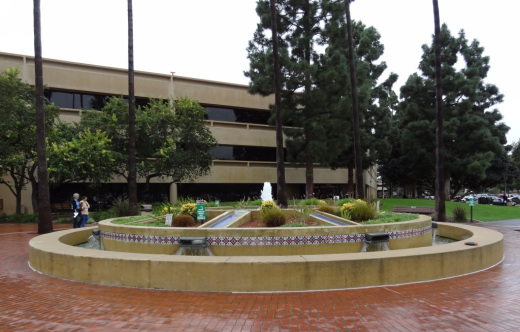
Courtyard area in front of Hall of Justice building

Courtyard area in front of Hall of Justice building

Jury service is not voluntary, and there is no permanent excuse to serving. Any request for excuse must be submitted in writing. Any request to be excused from serving on a jury trial due to loss of income and/or business closure must be directed to a trial judge, only after you have appeared and have served one day as summoned. Unless notified in writing that your request for excuse is granted, you may assume it has been denied. If the date of appearance is not satisfactory, you may request a postponement to a future date within 90 days. When listing reasons such as medical, job, or dependent care issues, be prepared to receive a postponement and not an excuse.

For more information about Jury Service in Ventura County, visit www.ventura.courts.ca.gov/JuryService.

California Drivers Are Not Necessarily Required to Have Auto Insurance

Yes, it is true, technically, the law does not state that drivers in California MUST carry auto insurance.

However, California Vehicle Code Section 1656.2 does have certain "compulsory financial responsibility" requirements most easily met by maintaining valid auto liability insurance that covers, at a minimum, $15,000 for injury/death to one person, $30,000 for injury/death to two or more persons and $5,000 for property damage.

Alternatively, the law allows financial responsibility to be met in one of three other ways: a cash deposit of $35,000 with the DMV, a DMV-issued self-insurance certificate or a surety bond for $35,000.

Now, if someone can actually afford to leave a $35,000 deposit with the DMV, they probably have a lot more assets that could be put at risk without adequate insurance in place. Probably not a good idea. I called the DMV Financial Responsibility Unit. Apparently some people leave the cash deposit who feel they spend too much on premiums over the years. Or perhaps if they import a car that is difficult to insure.

I also asked about the "self insurance" option and laughed when I heard you need a net worth of at least $2.2 million and a fleet of 25 or more cars. Not really geared toward most individuals.

Posting a surety bond for $35,000 is an alternative to insurance but the cost can be significant, generally ranging from 1 to 5% of the value of the bond.

A Low Cost Auto Insurance Alternative

As we know, auto insurance can be expensive. The California Low Cost Automobile (CLCA) Insurance Program was established in 1999 to help income-eligible drivers with good driving records purchase liability insurance that meets State requirements.

To qualify for a CLCA insurance policy, you must

Read More

What Happens When You Turn 18 in the State of California?

Age 18 in the United States is considered the "age of majority" and is a major milestone.

Age 18 has been the age of majority since the 26th Amendment, signed into law by President Nixon in July 1971. Historically the age of majority was 21, but when Franklin D. Roosevelt lowered the military draft age to 18 during World War II, there was a push to align the voting age with the military draft age.

So what changes when you turn 18? The State Bar of California previously published a nice guide for teenagers to help better understand how their rights and responsibilities change at age 18.

Here's a summary of these rights and responsibilities, excerpted from the California Lawyers Foundation booklet (updated in 2025), “When You Turn 18 - A Legal Survival Guide” (pdf file) (Spanish language version):

  1. Enter into binding contracts - for example, leases, opening bank accounts and applying for loans (of course, to obtain the loan, you may still need a co-signer).

  2. Buy or sell property, such as real estate and stock.

  3. Marry without written consent of parents or guardian.

  4. Sue or be sued.

  5. Compromise, settle or arbitrate a claim.

  6. Make or revoke a will.

  7. Inherit property outright.

  8. Vote in federal, state and local elections. (Since 2016, 16 and 17 year olds may pre-register to vote at age 18.)

  9. Consent to all types of medical treatment.

  10. Join the military without parental consent. Male U.S. citizens or immigrants living in the U.S. generally must register with the Selective Service System within 30 days of turning 18. (Females are not currently not required to register for the draft.)

  11. Get a job without a special work permit.

  12. Serve jury duty.

  13. Be subject to more serious consequences for breaking the law.

  14. Prior to June 9, 2016, you could buy tobacco products. The law changed, however, and now you have to wait until you are age 21. This also includes e-cigarettes and vaping products.

  15. At age 18 you can give blood without parental consent in California (written parental consent is required for 16 and 17 year olds).

  16. At age 18 you may become an organ donor without parental consent. www.organdonor.gov/about/donors/child-infant.html

  17. Apply for credit in your own name, though you will likely need to show proof of income or have a co-signer.

  18. You can get a tattoo at age 18 and can do so without parental consent. You cannot get a tattoo under the age of 18. It is a misdemeanor to give or even offer to give a tattoo to someone under the age of 18 in California. (PC 653)

  19. You can get a piercing without parental consent at age 18.

  20. You can file a petition to change your name at age 18.

  21. You can play the Lottery at age 18 in most states (except Iowa and Louisiana - party poopers).

  22. In California and most states (except Arizona, Iowa, Nevada and Texas), you can bet on horse races (e.g. pari-mutuel betting).

  23. You can play charity bingo at age 18 in California.

What you still cannot do:

  1. Purchase tobacco products, e-cigarettes and vaping products (mentioned above). You must be age 21. In fact, federal law changed in December 2019 to require all states to change the minimum age for tobacco purchases to 21.

  2. Purchase and consume alcoholic beverages. The minimum age for drinking in all states is 21.

    Some states have minor (so to speak) exceptions to the age 21 requirement. In Kansas, under 21 may drink “cereal malt beverages” under parental supervision on their own property. What is a cereal malt beverage? A beverage with no more than 3.2% alcohol by weight produced by fermentation, not by distillation. Coors Light has 4.2% alcohol as a comparison. The states of Alaska, Connecticut, Louisiana, Maine, Maryland, Ohio and Wisconsin have exceptions that allow individuals under age 21 to drink when parents or guardians are present. If you are 18 and really want to drink, the territories of Puerto Rico and the Virgin Islands allow legal drinking, unencumbered by the presence of parents, at age 18.

  3. You cannot sell or serve alcoholic beverages for consumption on-premises until you are age 21. However, it is allowable for someone 18 to 21 to serve alcoholic beverages to consumers in a restaurant along with food for consumption on premises.

Purple Heart Trail Signs on U.S. Highway 101 in Ventura County Commemorate Veterans

Purple Heart Trail.JPG

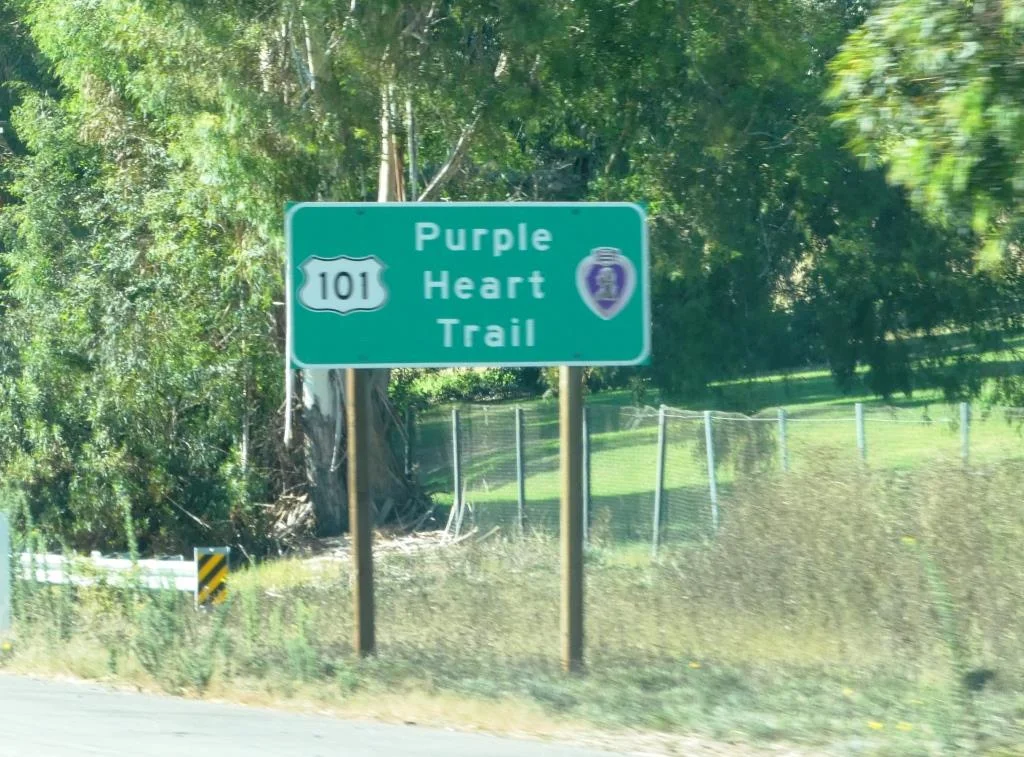
In November 2014, Caltrans District 7 installed two signs designating a segment of U.S. Highway 101 as part of the National Purple Heart Trail — a system of signed highways, bridges and other monuments that honor soldiers who have received the Purple Heart medal.

One of these signs can be seen on the northbound 101 in Thousand Oaks, right before the Westlake Boulevard offramp. The other sign is near the Bates Road offramp off the southbound 101.

These two signs complete 240 continuous miles of Purple Heart trail in California, from Ventura County to Monterey.

Senate Concurrent Resolution No. 27 established specified portions of US Highway 101 in the counties of Santa Barbara and Ventura for inclusion in the National Purple Heart Trail.

The U.S. 101 in Ventura County is also dedicated to the U.S. Army's 101st Airborne Division as commemorated by "The Screaming Eagles Hwy - 101st Airborne Division" placed nearby.