Rattlesnake Do's and Don'ts in the Trails of the Conejo Valley and Neighboring Areas

I've seen more snakes in the trails of the Conejo Valley in recent years than I can ever recall, some, but not all of which are rattlesnakes.

According to the California Department of Fish and Wildlife, rattlesnakes are generally not aggressive but can strike when they feel threatened or provoked. If you come across one on the trail, just back off and give them room to retreat. They don't want to mess with you!

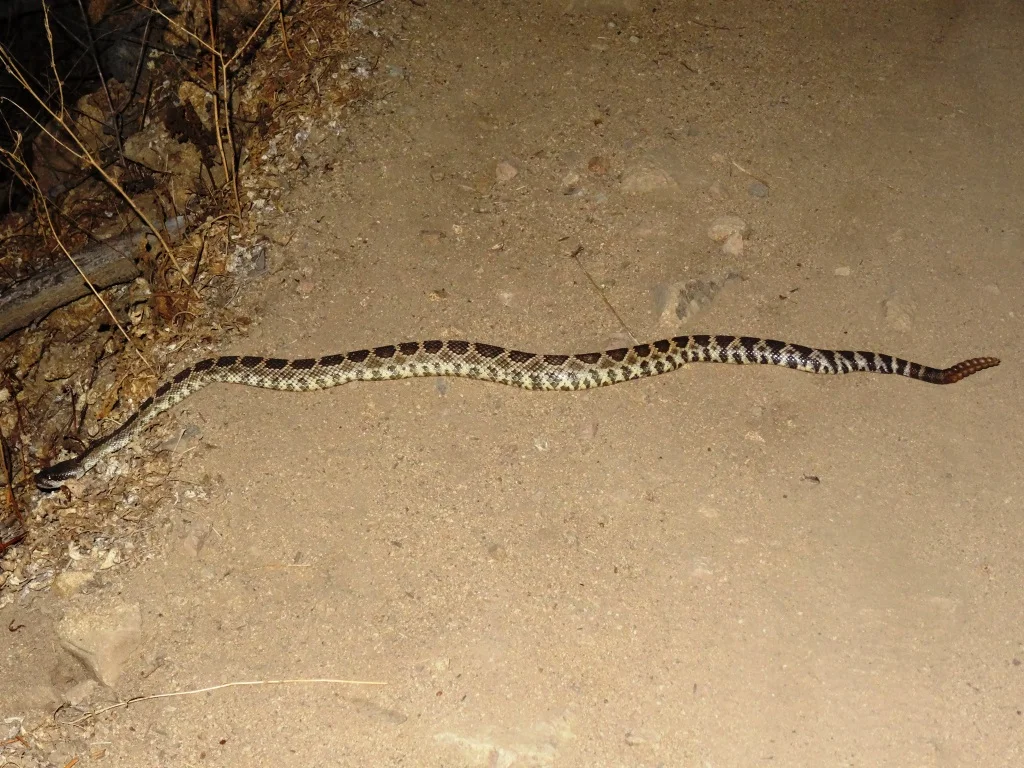
Rattler crossing the Rosewood Trail on a sunset hike.

Rattler crossing the Rosewood Trail on a sunset hike.

It is rare that rattlesnakes cause serious injury to humans. According to the California Poison Control Center, rattlesnakes account for 800 bites each year, with only one or two deaths. Most bites occur during the months of April through October, when both humans and snakes are active outdoors. About 25% of bites are dry (i.e. no venom), but still require medical treatment.

Do's and Don'ts

  • Wear shoes when out hiking in the trails.

  • Stay ON the trails...don't venture out into the underbrush, where snakes may be hiding.

  • Watch what you touch with your hands too...especially if it's dark and hard to see.

  • Leave them alone. They are fun to watch, but do so from a distance. Don't try to pick them up.

Is it a Rattler or a Gopher Snake?

On the trails of the Conejo Valley I've come across rattlesnakes, gopher snakes, king snakes, garter snakes and perhaps a few others I wasn't able to identify. The rattlesnakes are the ones to be particularly wary of because of their venom, so be aware of the following distinctions:

Rattlesnakes are wider/heavier than most of the other local snakes and have a triangular-shaped head, broader at the back than at the front, with a distinct "neck." They have openings between the nostrils and the eyes. There are a series of dark and light bands near the tail which look different from the markings on the rest of the body.  DO NOTE that rattles may not always be present as they may have fallen off are are not always developed on a young rattler.

For some great information on identifying California snakes, visit www.californiaherps.com/identification/snakesid/common.html.

Notice the stocky size of this rattlesnake, the clear rattle, and the different series of dark and lights bands leading down towards the rattle.

Notice the stocky size of this rattlesnake, the clear rattle, and the different series of dark and lights bands leading down towards the rattle.

Beautiful King Snake (known for lunching on rattlesnakes).

Beautiful King Snake (known for lunching on rattlesnakes).

Gopher snake crossing the trail in Rancho Sierra Vista/Satwiwa.

Gopher snake crossing the trail in Rancho Sierra Vista/Satwiwa.

Gopher snake on the Vista Del Mar Trail in Newbury Park.

Gopher snake on the Vista Del Mar Trail in Newbury Park.

President Trump Issues Executive Order to Postpone Easter Sunday to Sunday, July 5th

Trump Eggs.jpg

In response to the COVID-19 pandemic, President Donald J. Trump has issued an executive order to defer celebration of Easter Sunday from April 12th to July 5th, 2020. Here is a transcript of Trump’s remarks at signing of the order.

Trump: The whole world is inflicted with this horrible, horrible virus. With Easter just 11 days away, I decided we need to do something big, very, very big, to show the children of this country that they are not forgotten. This was a tremendous decision that I have to say, no other President in the history of the United States has ever done. Huge, very huge. A tremendous, tremendous decision, the likes of which no one, I’m told, by many other people, that no one, no one, has ever even thought about doing.

By rescheduling Easter to Sunday, July 5th, the day after July 4th, we have a terrific opportunity to do something never done in history. And it will be a very, very great thing. Something that is, just, incredible., really incredible. Melania and I will be hosting the largest Easter egg hunt in history on the White House lawn that day. Believe me, it will be the greatest Easter egg event ever seen. People have told me that it would be spectacular. We’ll have eggs with chocolate, jelly beans, maybe other things. Maybe money. A lot of it. We’ll see what happens.

Vice President Pence: I can’t emphasize enough the incredible decision that President Donald J. Trump, has made. Moving Easter Sunday 12 weeks into the future gives us the opportunity to stretch Lent out by another 12 weeks. Thank you so much, Mr. President.

Trump: Good ole’ Mike. I can’t wait. Now stand over there. You’re too close to me. Remember, folks, to practice social distancing. Mike, you’re a good man. But you need to give me six feet clearance. Now, press, we have time for one question, then we have to go. Jim, go ahead.

Jim Acosta: Mr. President, I understand that Easter Sunday will be a challenge to celebrate this year because of the coronavirus pandemic. But does it really make sense to push this holy day back 12 weeks?

Trump: That is a terrible question. You are fake news. Thank you everyone!

The Easter Conejo

The Easter Conejo

APRIL FOOL’S!!

The Coronavirus Aid, Relief, and Economic Security (CARES) Act and Other COVID-19 Recovery Programs

1200.jpeg

The Coronavirus Aid, Relief, and Economic Security (CARES) Act was passed by the Senate and is anticipated to be approved by the House tomorrow and signed into law by the President. CARES provides over $2 trillion in relief. About a quarter of the cost of the bill are "Recovery Rebate" checks we've heard about. Here's a summary of this program:

1. Payouts will be up to $1,200 per adult ($2,400 if married filing jointly) plus $500 per child under age 17.

2. Single taxpayers with adjusted gross income (AGI) up to $75,000 will receive a full $1,200 payment. The payment phases out by $5 for every $100 in AGI over $75,000, which means payments are reduced to zero at an AGI of $99,000.

3. Married taxpayers with AGI up to $150,000 will receive a full $2,400 payment. The payment phases out by $5 for every $100 in AGI over $150,000, which means the payment phases out at $198,000.

4. Head of household taxpayers with AGI up to $112,500 will receive a full $1,200 payment. The payment phases out by $5 for every $100 in AGI over $112,500, which means the payment phases out at $136,500 in AGI.

5. Taxpayers will receive an additional $500 per child under age 17, although it is unclear as of what date the age is determined.

6. The AGI is calculated based on your 2019 return, if filed; if not, your 2018 return.

7. You’ll be paid via direct deposit if they have your banking information on your last return; if not, then via check.

8. When? Starting sometime in April, until TBA.

9. I claim my parents as dependents. Will they receive checks? No.

10. Will it be taxable? No. It will be a refundable tax credit on your return.

11. Although the initial payments are based on your 2018 or 2019 tax returns, technically the payments are based on the AGI in your 2020 returns. What this means is that while you may not have qualified based on your 2018/2019 return, you may still qualify for the payment based on your 2020 return that will be filed in 2021. Inversely, if your 2020 AGI renders a smaller payment or no payment, I believe you will not have to pay the $$ back (this could change).

An example:

You are married with 2 kids under 17 and your 2019 AGI was $170,000. Your maximum payment is $3,400. But it is reduced by $1,000 ($170,000 - $150,000 = $20,000. $20,000 divided by $100 = 200. 200 x $5 = $1,000). Total payout is $2,400.

In February 2021 you file your 2020 return. Your AGI dropped to $150,000. Your payout will be increased to $3,400. You were previously paid $2,400, so you’ll receive another $1,000 credit on your 2020 tax return.

Here are some additional financial resources for those struggling as a result of the COVID-19 pandemic situation:

Penalty-Free IRA Withdrawals

CARES enables those impacted by COVID-19 to withdraw up to $100,000 from qualified retirement plans without penalty in 2020, though you will still owe taxes on the withdrawal, stretched over 3 years.

Unemployment: In states where the President approves a major disaster declaration, federal assistance comes in the form of Disaster Unemployment Assistance (DUA). DUA is generally available to any unemployed worker or self-employed individual who cannot work as a result of the disaster.  Learn more about this on the Calif EDD website at www.edd.ca.gov/unemployment/disaster_unemployment_assistance.htm.

SBA Loans: Small business owners are eligible to apply for low-interest loans due to COVID-19 with the SBA. Details at disasterloan.sba.gov/ela. There are also SBA Express Disaster Bridge Loans available for certain businesses that have existing relationships with an SBA Express Lender.

CARES also expands the SBA loan program to support new “Paycheck Protection Program” loans that would increase loan amounts and allow use for payroll, mortgage, rent and utility payments, insurance and other debt. Certain borrowers may be eligible for loan forgiveness for an 8 week period for payroll, interest, rent and utilities while retaining employees over that period (effectively an incentive to retain staff during the COVID-19 crisis).

City of Los Angeles Small Business Emergency Microloan Program offers business in the City of L.A. to apply for low-interest loans of $5K to $20K ranging from 6 months to 5 years. Details at www.edd.ca.gov/unemployment/disaster_unemployment_assistance.htm.

Bank Leniency: A number of banks are implementing programs to defer payments, suspend late penalties on loans, extend credit limits and payment deadlines and other things for those impacted by COVID-19. Contact your bank for details. A partial list of such banks is at abc7ny.com/6046582/.

Tax Return and Related Deadlines

Both federal and California tax returns due 4/15/20 have been pushed to 7/15/20. Additionally, any federal/California tax payments due 4/15/20, including 2019 taxes as well as 2020 estimated and franchise tax payments, have been pushed to 7/15/20. The Calif 2nd quarter estimated payments due 6/15/20 have been pushed to 7/15/20. The federal 2nd quarter estimated payments at this point in time are still 6/15/20.

IRA contributions for 2019 due to be made by 4/15/20 have also been extended to 7/15/20.

REAL ID Deadline Has Been Delayed From October 1, 2020 to October 1, 2021 by DHS

REALID.png

Today, Acting Secretary of the Department of Homeland Security (DHS) Chad Wolf announced that, due to circumstances resulting from the COVID-19 pandemic and the national emergency declaration, the DHS as directed by President Donald J. Trump, is extending the REAL ID enforcement deadline beyond the current October 1, 2020 deadline. The new deadline for REAL ID enforcement is October 1, 2021. DHS will publish a notice of the new deadline in the Federal Register in the coming days.

Wolf indicated “The federal, state and local response to the spread of the Coronavirus here in the United States necessitates a delay in this deadline. Our state and local partners are working tirelessly with the Administration to flatten the curve and, therefore, we want to remove any impediments to response and recovery efforts. States across the country are temporarily closing or restricting access to DMVs. This action will preclude millions of people from applying for and receiving their REAL ID. Extending the deadline will also allow the Department to work with Congress to implement needed changes to expedite the issuance of REAL IDs once the current health crisis concludes.”

“Protecting both the health and national security of the American people continues to be the top priority for the President of the United States and the Department of Homeland Security.”

www.dhs.gov

Neil Diamond Sings "Sweet Caroline" Updated with a COVID-19 Reminder in the Lyrics

Neil Diamond released “Sweet Caroline” in May 1969, well over 50 years ago. Diamond’s inspiration for the song was John F. Kennedy’s daughter, Caroline, who was 11 when the song was released.

Today he released a slightly modified version of Sweet Caroline on his YouTube channel with a subtle COVID-19 reminder to wash your hands!

“Hands,

Washing hands,

Reaching out,

Don’t touch me…

I won’t touch you.”

For local area COVID-19 updates in the Ventura County area, visit THIS LINK.

Reminder About How to Deal with Coyotes in the Conejo Valley and Surrounding Areas

Coyote5_2014.JPG

Living in the Conejo Valley, surrounded by thousands of acres of open space, most of us come into contact with coyotes from time to time. Coyotes are a vital component of rural and urban communities, deserving of respect for their adaptability, resilience and intelligence. Below are some tips on coyote awareness, courtesy of Project Coyote.

Facts:

  • Coyotes are members of the dog family; they are curious, adaptable, and learn quickly.

  • Coyotes often mate for life, are devoted parents, and are highly communicative (barks, yips, howls).

  • Coyotes weigh 18-35 pounds in the West.

  • Coyotes may be more protective of dens/territories during pup rearing (April-Aug).

  • Coyotes eat large numbers of rodents and rabbits, as well as fruit, vegetation, insects and carrion. They help keep ecosystems vital, healthy and clean.

  • Coyotes are naturally wary of people but can adapt to our presence and the reliable food sources that we provide.

Coyote1_2014.JPG

Safety:

  • DON’T FEED COYOTES. Their life and your safety depend on coyotes remaining wild and naturally wary of people.

  • Remove attractants; pick up trash, secure garbage, and feed pets inside. Don’t leave food or pets outside at night.

  • Walk dogs on leashes, especially during pup rearing season (April-Aug). Pick up your small dog if you see a coyote and don’t let pets roam.

  • If approached, don’t run. Wave arms, make noise and walk toward the coyote until he retreats. Be “Big, Bad and Loud.”

  • Avoid areas where coyotes may be denning or feeding/hiding pups.

  • Appreciate coyotes from a distance. Share this information with family and friends.

Coyote3_2014.JPG
Coyote6_2014.JPG

California Minimum Wages Increased Today, January 1, 2020 by $1 Per Hour

If you are a minimum wage earner in California, today you received a pay increase of either 9.1% or 8.3%.

Huh? Well it depends on if your employer has 25 or fewer employees or 26 or more employees. If you work for a smaller employer (25 or less employees), the California minimum wage increases from $11 to $12 per hour. If you work for a larger employer (26 or more employees), your wage increases from $12 to $13 per hour.

Hmm, that brings an interesting idea to mind. If you are a minimum wage earner at a smaller company as defined, you could actually receive an 18.2% increase in 2020 simply by finding a larger employer!

In any case, by law, California minimum wage rates for all companies will be raised to $15 per hour with $1 increases on January 1st of each year by 2022 for larger employers and 2023 for smaller employers. See charts below.

MinWage1.1.20.JPG

The federal minimum wage for 2020 is $7.25, a rate that has stood frozen in time since it became effective on July 24, 2009.

California minimum wage rates apply to Ventura County residents. But City of Los Angeles and County of Los Angeles minimum wage rates are currently higher than Ventura County/California wage rates. They are currently:

  • $13.25 for employers with 25 or less employees until 7/1/20, when the rate increases to $14.25 per hour. The rate subsequently increases to $15 per hour 7/1/21.

  • $14.25 for employers with 26 or more employees until 7/1/20, when the rate increases to $15 per hour.

Looking for a higher minimum wage? Move to San Francisco, where the rate is currently $15.59 per hour and will be adjusted for inflation on July 1, 2020.