Ventura County 2-1-1 for Human Service Programs

Ventura County 2-1-1 provides a quick, easy, free and confidential way to obtain information and local referrals for these types of services:

  • Basic human needs, such as food, shelter, clothing and other support

  • Physical and mental health resources, including intervention services, crisis counseling, support groups, counseling, drug and alcohol intervention and health insurance programs

  • Employment support, including unemployment assistance, job training, education assistance, transportation help, etc.

  • Support for elderly and disabled individuals, such as convalescent care, home health care, meal services and transportation services

  • Children, youth and family support, including childcare, after school programs, family resource centers, mentoring, recreation, tutoring, protective services, etc.

  • Volunteer opportunities and donations

Ventura County was the first county in California to launch 2-1-1 service on February 11, 2005.  The Ventura County 2-1-1 service is staffed 24 hours a day and is managed by Interface Children & Family Services with the support of the Ventura County United Way and First 5 Ventura County. Additional support is received from the County of Ventura, the County of Ventura Health Care Agency, the County of Ventura Human Services Agency, and the cities of Camarillo, Ventura, Oxnard, Simi Valley, Port Hueneme, Moorpark, Ojai and Thousand Oaks.

For more information about 2-1-1, visit www.211ventura.org.

Identify Local Sex Offenders Using California Megan's Law Website

MegansLaw.jpg

California was the first state in the nation to initiate a Sex Offender Tracking Program in 1947, but until 1996, when California Megan's Law (CML) was initiated, information about sex offenders was not publicly available. 

Megan's Law is named after seven year old New Jersey girl Megan Kanka, who was raped and killed by a known molester who lived across the street from her family. All states now have a form of Megan's Law. On September 24, 2004, AB 488 was signed into law in California, providing the public Internet access to sex offender information at www.meganslaw.ca.gov.

This is a website that deserves a look, particularly by anyone who is a parent. While the website is not meant to "punish" sex offenders, it is a useful awareness tool. The search engine on the site allows you to search by name, address, city, zip and county, as well as within a two mile radius of parks and schools. You can also review the results of your search in both map and listing format.

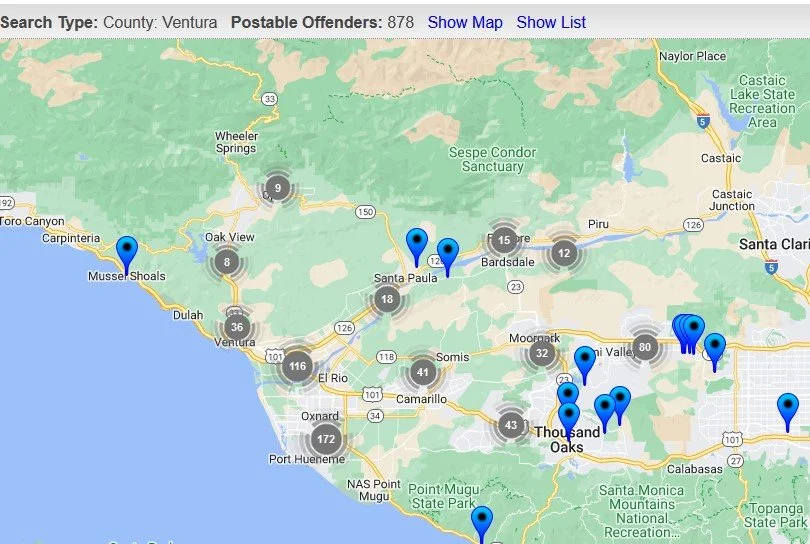
Within seconds you can identify the 880=1 (as of July 2024) registered sex offenders in Ventura County, including photos, names, vital stats like date of birth, height and weight, their offenses and, where applicable, their addresses. You can view the offenders on a map or on a list.

Map view of megan’s Law offenders in Ventura County as of January 2023

The information in the CML database is not always up to date for each individual. The severity of the offenses for each individual vary from the more violent (rape, battery) to statutory rape, indecent exposure, etc.

Digitally Preview Your Mail Each Morning with USPS Informed Delivery

Informed Delivery by USPS allows you to preview your mail each morning with a digital copy of each letter-sized item to be delivered to you via email. You can also log in anytime and see images of previous week’s mail. Additionally, you can see the delivery status of any packages coming your way.

If you’ve ever had your mail stolen, this gives you the ability to at least see what mail was stolen from you. Or you can see first thing in the morning what mail is being delivered, alerting you to anything of particular importance.

You will see the address side of mail delivered. You of course will not be seeing contents of that mail.

Learn more and sign up at informeddelivery.usps.com.

Daylight Saving Time is Back ALREADY on Sunday, March 10th!

Daylight Saving** Time is coming back again! Yes, this will take place on Sunday, March 10, 2024, at 1:59 a.m. When the clock strikes 2 a.m. that morning, you will lose one hour of beauty sleep.

So try to get to bed early the night of March 9th or you might feel grumpy on Monday! Especially when you realize it feels a lot darker that morning. But the good thing is it'll be a lot lighter out at dinnertime!

** Contrary to what many of us think, it is called Daylight Saving Time, not Savings Time. Make sure to correct anyone who says it wrong if you really want to get on their nerves. But the reality of it is that we're not saving any daylight, we're just shifting it around.

Income Planning to Keep Your Medicare Part B Premiums From Increasing

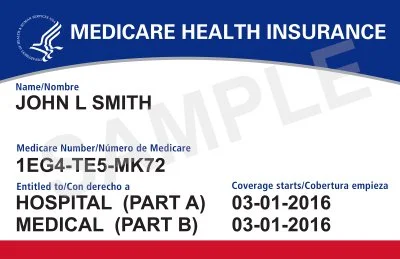
Medicare Part B covers certain doctor services, outpatient care, medical supplies and preventive services. You pay a monthly premium for Part B that is automatically deducted from your Social Security benefit payment.

Most people will pay the standard premium amount. If your modified adjusted gross income (MAGI) is above a certain amount, you may be charged an Income Related Monthly Adjustment Amount (IRMAA) - basically a higher premium.

Your MAGI is your total Adjusted Gross Income plus tax-exempt interest income, non-taxable Social Security benefits and untaxed foreign income on your tax return.

Medicare uses the MAGI reported on your IRS tax return from 2 years ago to determine your current year premium.

For example, the standard Part B premium in 2023 is $164.90. If your MAGI on your 2021 return was $97,000 or less if single or $194,000 or less on a joint tax return, you pay the standard 2023 premium.

If the MAGI on your 2021 tax return was between $97,000 up to $123,000 (single taxpayers) or between $194,000 up to $246,000 on a joint return, your 2023 premium would be $230.80.

There are additional income ranges that can bring your monthly premium as high as $560.50 per month in 2023, if your MAGI in 2020 was $500,000 or more for single or $750,000 or more for joint taxpayers. Visit www.medicare.gov/your-medicare-costs/part-b-costs for more details.

These bunnies are too young for Medicare but are discussing future healthcare options nonetheless.

ARE YOU FILING AS MARRIED FILING SEPARATELY? BE CAREFUL!! If your individual MAGI is above $97,000 and less than $403,000, your monthly premium jumps from $164.90 to $527.50. That’s a huge jump.

TAX PLANNING: Let’s say you are single and have $45,000 in Social Security, $35,000 in IRA distributions and $15,000 in interest and dividends in 2021. That brings you to $95,000 in MAGI, which is below the $97,000 threshold where they increase your premiums. If you sold a stock for a $2,001 gain, that would bring you to $97,001 in MAGI and your monthly premium would jump by $66 per month. Perhaps it would be wise to wait and sell that stock in 2022.

The only problem is, Medicare doesn’t announce next year’s premium parameters until the fall, which usually is after you’ve filed your previous year tax returns. What to do?

Well here we are near the end of 2023, which will be used to establish 2025 Part B premiums. The best you can do is just use the 2021 parameters and plan accordingly.

The MAGI cut-off for standard premiums in recent years have changed as follows:

  • 2021 (for 2023): $97,000 (single), $194,000 (joint)

  • 2020 (for 2022): $91,000, $182,000

  • 2019 (for 2021): $88,000, $176,000

  • 2018 (for 2020): $87,000, $174,000

  • 2015-2017 (for 2017-2019): $85,000, $170,000

What happens if your income jumps really high one year? You sell a rental property, win the Lotto, take a new job, etc. Well, your premiums will jump if your MAGI leaps over those income parameters. Not much you can do about it. The good news is that it will drop back down the following year if your MAGI drops below the income threshold.

There are some unique situations where you are allowed to an appeal a Part B premium IRMAA after you receive your notice from the Social Security Administration. Certain life-changing events that cause an income decrease can be considered to reduce your premium, such as death of a spouse, marriage, divorce, reduction in work hours, loss of pension, involuntary loss of income-producing property due to a disaster and receipt of settlement from employer due to closure or bankruptcy.

Visit www.medicare.gov for more information.

How to Be Coyote Aware in the Conejo Valley and Greater Ventura County

Coyote1.jpg

Living in the Conejo Valley, surrounded by thousands of acres of open space, most of us come into contact with coyotes from time to time. Coyotes are a vital component of rural and urban communities, deserving of respect for their adaptability, resilience and intelligence. Below are some tips on coyote awareness, courtesy of Project Coyote.

Facts:

  • Coyotes are members of the dog family; they are curious, adaptable, and learn quickly.

  • Coyotes often mate for life, are devoted parents, and are highly communicative (barks, yips, howls).

  • Coyotes weigh 18-35 pounds in the West.

  • Coyotes may be more protective of dens/territories during pup rearing (April-Aug).

  • Coyotes eat large numbers of rodents and rabbits, as well as fruit, vegetation, insects and carrion. They help keep ecosystems vital, healthy and clean.

  • Coyotes are naturally wary of people but can habituate to our presence and the reliable food sources that we provide.

Safety:

  • DON’T FEED COYOTES. Their life and your safety depend on coyotes remaining wild and naturally wary of people.

  • Remove attractants; pick up trash, secure garbage, and feed pets inside. Don’t leave food or pets outside at night.

  • Walk dogs on leashes, especially during pup rearing season (April-Aug). Pick up your small dog if you see a coyote and don’t let pets roam.

  • If approached, don’t run. Wave arms, make noise and walk toward the coyote until he retreats. Be “Big, Bad and Loud.”

  • Avoid areas where coyotes may be denning or feeding/hiding pups.

  • Appreciate coyotes from a distance. Share this information with family and friends.

Coyote4.jpg
Coyote2.jpg

All About the Previously Owned Clean Vehicle Credit

NOTE: New legislation signed in July 2025 eliminates the Previously Owned Clean Vehicle Credit beginning in October 2025.

A brand new tax credit, the Previously Owned Clean Vehicle Credit, came about from the Inflation Reduction Act of 2022. This new credit applies to pre-owned all-electric, plug-in hybrid and fuel cell electric vehicles purchased on or after January 1, 2023 through 2032. The credit, which is non-refundable, is 30% of the sales price, up to a maximum credit of $4,000.

As with pretty much every tax law, lawmakers made sure to make the requirements for this credit as confusing as possible. Here are the main parameters:

  • The sales price, exclusive of taxes ad fees, much be $25,000 or less.

  • The model year of the car must be at least two years prior to the calendar year the car is purchased.

  • The car must be purchased from a licensed dealer, not a private party.

  • The buyer’s modified adjusted gross income (AGI) cannot exceed $150,000 for married filing jointly taxpayers, $112,500 for head of household filing status and $75,000 for other taxpayers, in either the year of purchase or the previous year.

  • The buyer cannot be claimed as a dependent by someone else.

  • You can’t claim the credit more than once every three years, based on the actual purchase date of the car.

  • The credit is applicable per taxpayer; the IRS as of this writing has not clarified if both spouses could claim the credit within the same three-year period. (That said, in theory they could file separately in the years they claim the credit.)

There are other specifics listed at www.fueleconomy.gov/feg/taxused.shtml#requirements.

Another important detail is that vehicles are only eligible for the credit for the first qualifying sale taking place on or after August 16, 2022. In other words, a used clean vehicle is not eligible for the credit after the first time, after 8/16/22, it is re-sold for $25,000 or less. How in the world will we know if that’s the case? Ask the dealer. They will know. What this means is that two cars with the same make, model and features offered at the same price of $25,000 or less…one them could be eligible for the credit while the other one is not.

As mentioned above, this is a non-refundable credit. This means that if you take the credit on your tax return, but your federal taxes are less than the credit, the excess goes away.

But wait…there’s a solution for that beginning in 2024! Starting this year, the credit can be transferred to the dealer and applied towards the sales price. The dealer, in turn, will receive the full credit from the IRS. The only catch is that you have to meet the AGI requirements mentioned above. If you file your tax return and do not meet those requirements, you’ll have to pay back the credit with your return. Whether you claim the credit at the dealer or on your return, you have to report the purchase on Form 8936.

Let’s use an example:

George is single and decides he wants to purchase a used EV. George expects his income to be $90,000 in 2024, but his 2023 return showed $70,000 in AGI, which qualifies him for the credit in 2024. He goes to the CarMax website and searches for electric cars at a price of $25,000 or less that are shown at www.fueleconomy.gov/feg/taxused.shtml.

George finds a 2013 Chevy Bolt for $13,000 but it shows it has had two owners. If it was already re-sold by a dealer to the 2nd owner after 8/16/22 for $25,000 or less, it is not eligible for the credit. The dealer will be able to tell you if this is the case. But let’s assume the previous sale took place before that date. George purchases the car for $13,000 plus sales taxes, license fees, etc., less the credit, because he chooses to transfer the credit to the dealer. The credit is 30% times $13,000, or $3,900. Enjoy your used Chevy Bolt, George! (Let’s hope the car’s battery still holds a decent charge.)

Looking for information on NEW clean vehicle car tax credits? Visit www.fueleconomy.gov/feg/tax2023.shtml.